The Colours We Traded
On the moment we mistook having for living, the strange history of a world gone grey, and how to come home to a life we never actually left.

Friend,
I want to tell you about a statue.
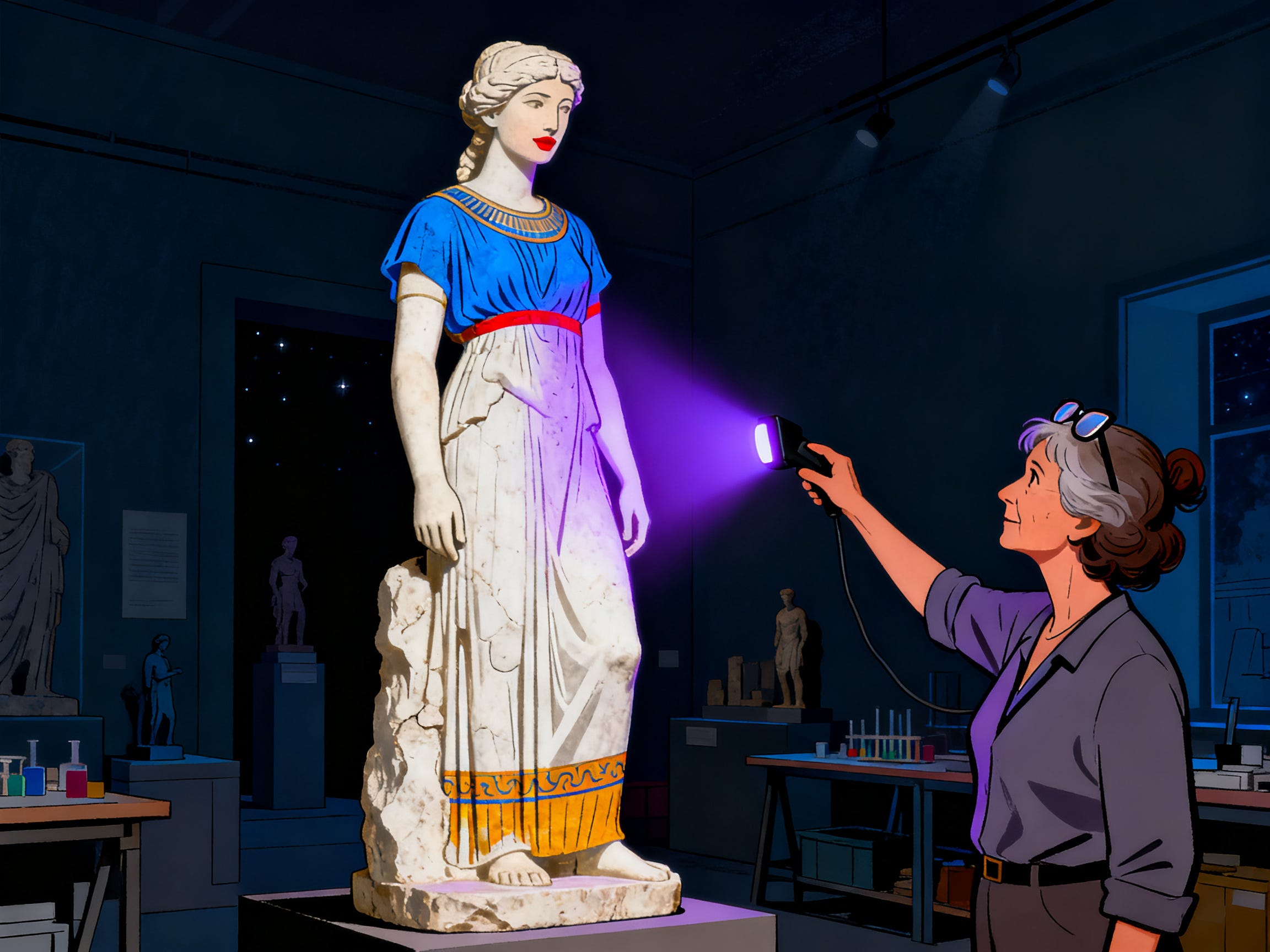
It stands in a museum in Athens, carved around 490 BC — a young woman, the Peplos Kore, cut from Parian marble. For two centuries, visitors have stood in front of her and admired what they believed was the essence of classical antiquity: pure, white, austere stone. Serene. Restrained. Timeless. An entire aesthetic civilization — neoclassical architecture, minimalist design, the white gallery wall, the beige apartment — traces its lineage, in part, back to the whiteness of statues like her.
Except she was never white.
Run ultraviolet light across her surface and the ghost appears: traces of Egyptian blue, cinnabar red, ochre, malachite green. Her dress was painted in saturated patterns. Her lips were red. Her hair was probably a warm auburn. The ancient Mediterranean was, by every archaeological account we now have, riotously, almost garishly colourful — temples in blue and gold, statues dressed like carnival dancers. The white marble we inherited is not antiquity. It is antiquity after two thousand years of weathering. The paint wore off, and we mistook the erosion for the ideal.
Think about what that means. We built an entire theory of beauty — of sophistication, of taste, of what a serious civilization looks like — on a misreading. On damage. We looked at a faded world and decided the fading was the point.
I keep coming back to this because I think it is not just a story about statues. I think it is a story about us. Somewhere along the way — and this letter is my attempt to locate the moment — we did to our own lives what time did to the Peplos Kore. We let the colour wear off. And then, stranger still, we started to prefer it that way. We made the grey aspirational. We photographed our beige kitchens and called it calm. We wore black to signal seriousness. We flattened our days into schedules and our schedules into productivity and our productivity into a number, and we called the number a life.
This letter is about when that happened, why it happened, and whether it can be unhappened. Fair warning: it is a personal one. There will be no supply chains this week. The system I want to examine is the one that decides, every morning, whether today will be lived or merely processed.
I. The Word We Broke
Start with a word. Free.
The etymology is not what you would expect. “Free” does not descend from words meaning unbound, or unowned, or without cost. It descends from the Proto-Germanic frijaz, which meant beloved — and it shares its root with the word friend. In the old Germanic household, the free people were the ones bound by love rather than by ownership: the family, the kin, the beloved — as distinct from the enslaved, who were bound by force. To be free, in the oldest layer of our language, did not mean to be unattached. It meant to be attached by love instead of by chains.
Sit with that for a moment, because it inverts almost everything the modern world has taught us about freedom. We have been sold a definition of freedom as subtraction: no obligations, no dependencies, no one waiting for you at home. Freedom as the empty calendar, the exit option, the ability to leave. An entire industry of aspiration — the private jet, the passive income, the beach with nobody on it — is built on freedom-as-escape.
But the word itself remembers something older. It remembers that the opposite of slavery was never solitude. The opposite of slavery was belonging to people who loved you.
And here is the trap, the one I fell into for most of a decade: if you define freedom as escape, then you must first accumulate the means of escape. You must earn the exit. And so freedom gets postponed — it becomes the thing you will have after. After the funding round. After the promotion. After the number in the account crosses the threshold. Luxury becomes the down payment on a freedom that never arrives, because the definition itself is broken. You cannot escape your way into belonging. You cannot purchase your way into being beloved.
Somewhere in the last century, we stopped asking whom do I love and who loves me and started asking what can I afford and what does it signal. That substitution — having for being, luxury for love — is, I have come to believe, the moment the colour started coming off the statue.
II. The Fifteen-Hour Week That Never Came
If you want to date the substitution precisely, there is a document that will serve.
In 1930, in the trough of the Depression, John Maynard Keynes wrote an essay called Economic Possibilities for our Grandchildren. In it, he made a prediction that was, in narrow technical terms, almost perfectly correct: that within a hundred years, productivity in the industrialized world would rise four to eight times over. It did. He then made a second prediction that was almost perfectly wrong: that we would use this abundance to work fifteen hours a week, and that the great human challenge of the twenty-first century would be leisure — what to do with our freedom, how to live “wisely and agreeably and well.”
The productivity arrived on schedule. The freedom did not. We took essentially none of the gains as time. We took them as stuff — bigger houses to store the stuff, faster vehicles to commute from the houses to the jobs that paid for the stuff, and screens, everywhere, to anaesthetize the part of us that suspected something had gone wrong with the exchange.
Keynes assumed that wants were finite — that once needs were met, humans would naturally turn to living. What he underestimated was our capacity to manufacture new wants at precisely the rate of our new productivity, and to convert every gain in possibility into a gain in consumption instead of a gain in life. The fifteen-hour week was technically achievable decades ago. We voted against it, every day, with our purchases. Nobody forced us. That is the uncomfortable part. The grey was not imposed. It was chosen — one reasonable, individually defensible trade at a time.
When did we stop living? There was no single moment. There was a compounding series of tiny moments, each one invisible: the evening walk traded for the extra hour of email. The saturated, inconvenient, unrepeatable experience traded for the efficient, repeatable, beige one. The friend traded for the network. A civilization does not lose its colour in a day, any more than a statue does. It happens at the speed of weathering — which is to say, at exactly the speed you cannot see.
III. What I Traded in My Twenties
Now the personal part, because I have earned no right to describe the trap without admitting I lived in it.
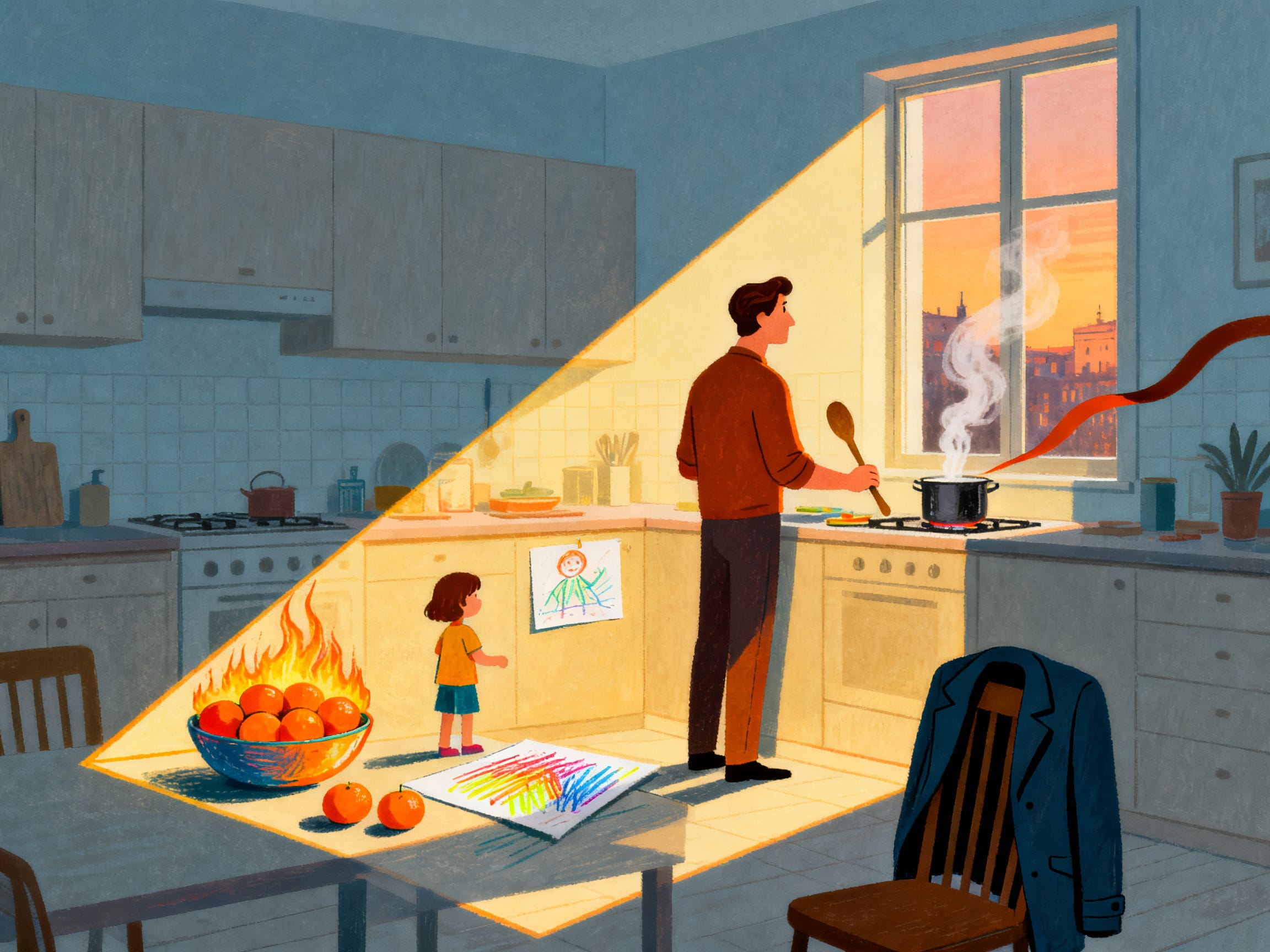
I spent my twenties believing that working on technology — on innovation, on the future — was itself a form of meaning. And I want to be careful here: some of it was. I do not disown that decade. But I notice, looking back, that I treated my own life as a kind of infrastructure project. Something to be built now and inhabited later. I was laying track toward a version of living that was always one milestone away. I optimized. I shipped. I read the news the way other people take medication — compulsively, joylessly, on schedule — and somewhere around the thousandth headline I noticed that I had started to hate the world I was supposedly working to improve.
That is a strange injury, and I suspect some of you carry it too: to be so saturated in information about the world that you lose all contact with it. I could tell you about collapsing systems on four continents. I could not have told you what the light was doing outside my window. I knew everything and touched nothing. The news had given me the world in black and white — literally in the old sense, and spiritually in every sense — and I had mistaken that transmission for reality, the way we mistook the faded marble for Greece.
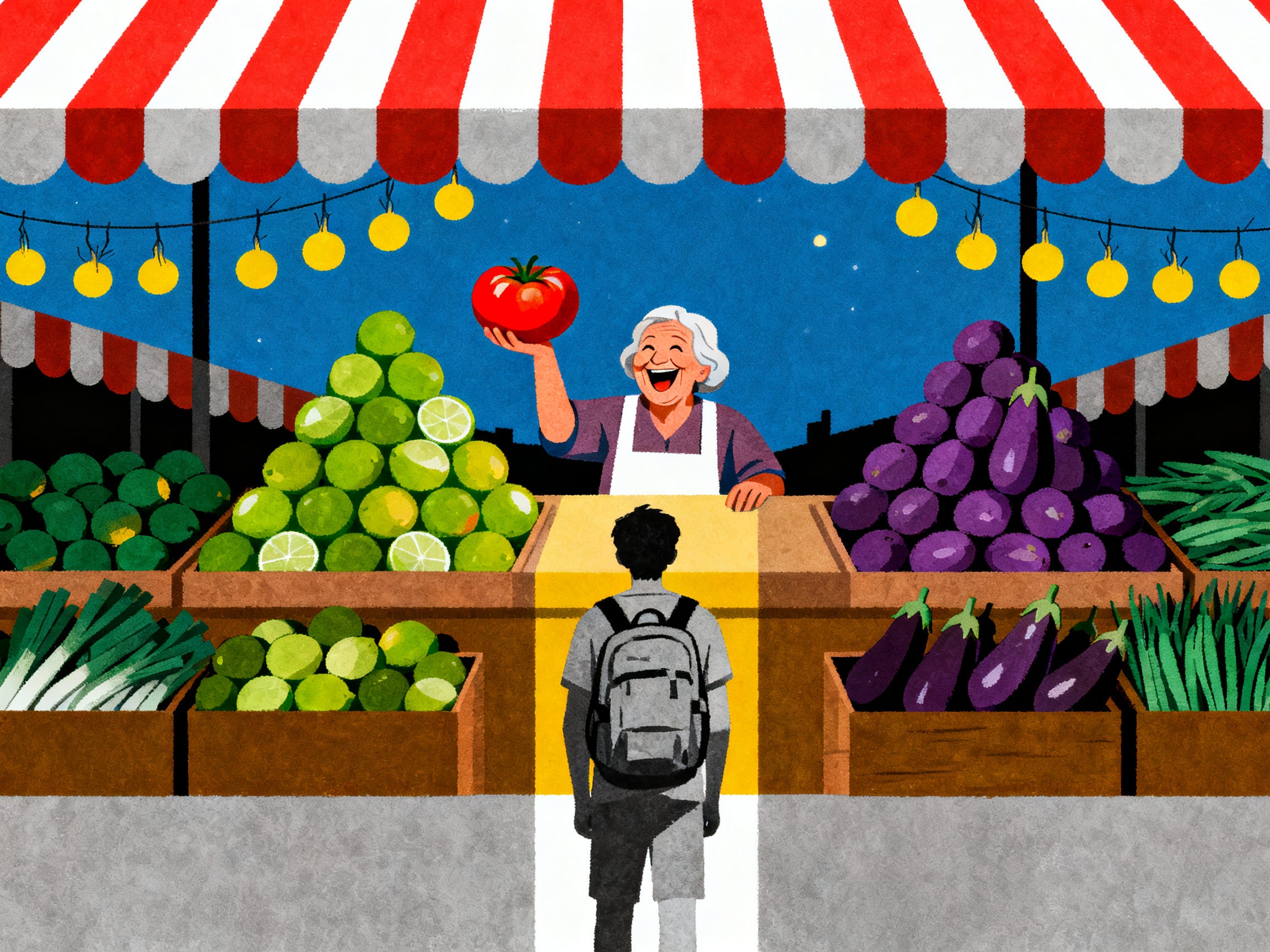
So I left. I traveled — not as achievement, not as content, just movement and distance. And the thing that happened out there was not that the world got better. The world did not change at all. What changed was resolution. Away from the feed, the world came back in colour: an old woman laughing at a market stall over vegetables whose shapes no supermarket would permit. Rain arriving over a valley like a decision. Strangers who owed me nothing and were kind anyway, again and again, in numbers no headline would ever report. I found love out there — love in a person, eventually, but first love in everything, the older kind the word free remembers. I found out that the world I had learned to hate was a low-resolution image of a place that, seen directly, is almost unbearably generous.
And now I am in my mid-thirties, and we are a family, and I have to make an honest confession to you: the feeling is back. The grey is creeping in at the edges again. The days have started processing instead of happening. And my first instinct — the old instinct — whispers the old solution: go. Travel. Movement. The geographic cure.
But I have been sitting with this for weeks now, and I think the instinct is wrong — or rather, out of date. Because chasing the same medicine would be chasing the wrong diagnosis. It was never the distance that healed anything. It was the attention. Travel simply forced my attention open; unfamiliarity did the work that discipline should have done. What I actually learned out there — and then forgot, because we always forget — is that colour is not a property of elsewhere. It is a property of looking. The market woman, the rain, the kindness: my street has all of it. My kitchen has all of it. The small ordinary world of a family — which no algorithm celebrates and no feed rewards — is not the grey compromise the culture quietly implies it is. It is the most saturated place I have ever stood. I just keep forgetting to look at it in ultraviolet.
IV. The Return of Colour
Here is something hopeful I have noticed, and I do not think I am imagining it.
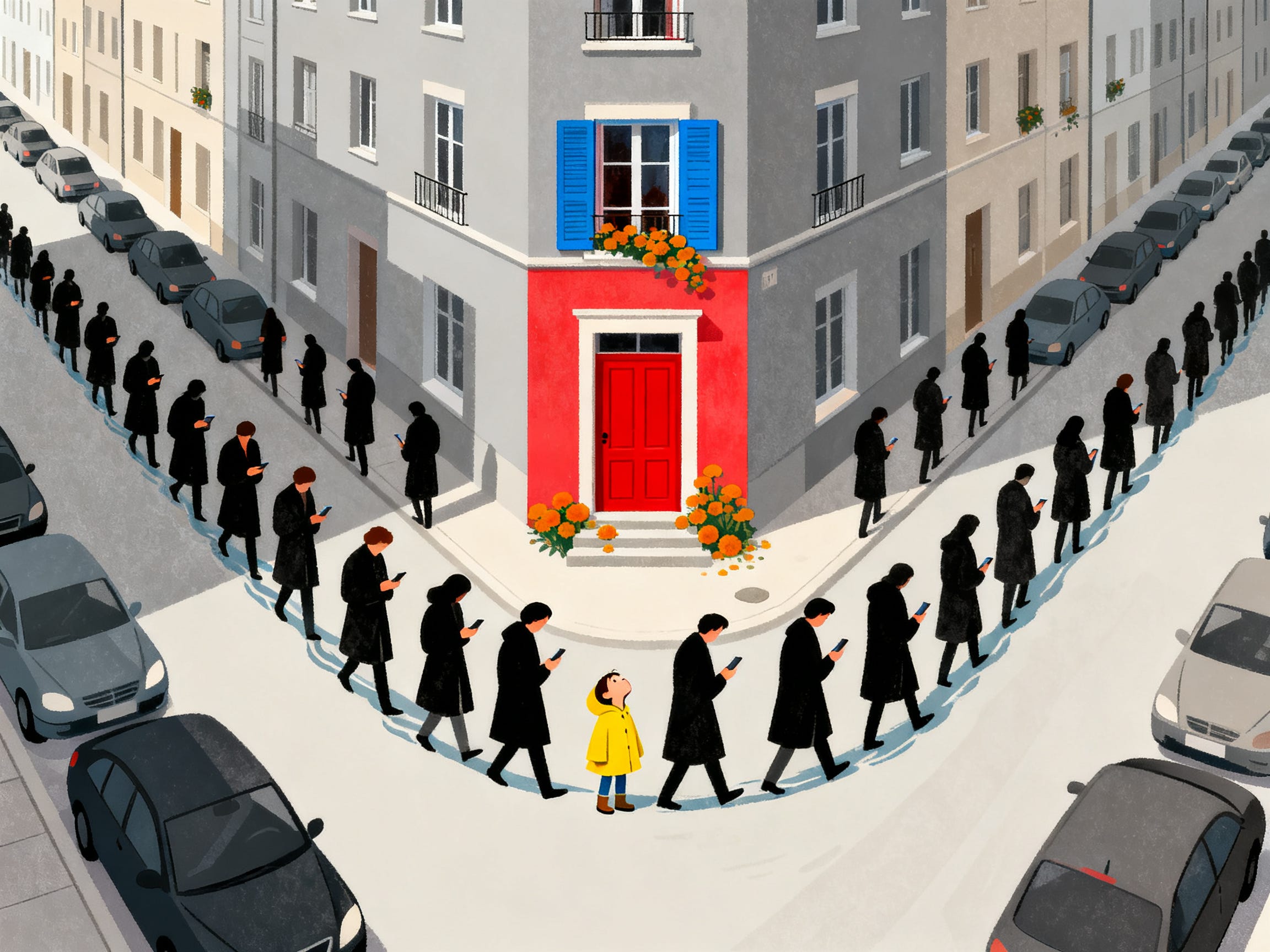
Being different is becoming interesting again. After decades in which everything converged — every city on the same glass towers, every apartment on the same grey-beige palette, every person on the same feeds wearing the same black — you can feel the first countercurrent. The hand-painted sign. The loud, unfashionable garden. People leaving platforms not in protest but in boredom. The renovated house whose owners, to the horror of the algorithm, chose colours. Small signals, but real ones: the monoculture is starting to bore even its own inhabitants. Sameness was sold to us as taste, and enough people have now lived inside it long enough to notice that it feels like nothing at all.
And this is where I get to say the one optimistic sentence I have complete confidence in: everything about this is reversible, because none of it is physics. The grey world is not a law of nature. It is an accumulation of choices, and choices have the interesting property of being remakeable every single morning. We decided, collectively and individually, that black and white was sophisticated, that busyness was virtue, that luxury was freedom, that elsewhere was where life happens. Every one of those decisions can be decided differently — not by civilization first, but by one household at a time, which is the only way civilizations have ever changed their minds anyway.
The archaeologists who found the paint on the statues did not restore antiquity. The colour was always there, a molecule deep, waiting for someone to shine the right light. I think our lives are like that. I do not think we stopped living. I think we stopped seeing that we are living — which feels identical from the inside and is entirely different in what it asks of us. The first tragedy would require us to build a new life. The second only requires us to look at this one properly.
What I’m Sitting With
A question, mostly. Not when did we stop living — I no longer believe we did — but: what is my ultraviolet light? What is the practice that makes the original paint visible on an ordinary Tuesday, in an ordinary kitchen, in this one specific and unrepeatable life?
I do not fully know yet. But I know what it is not. It is not the next milestone, and it is not the next departure gate. This time the seeing has to happen here — with these people, in this small world, which I am finally old enough to recognize as not small at all.
The statue was never white, friend. And your life was never grey. Go find the paint.
Before You Go — An Experiment I’m Considering
One more thing, and I say it with some hesitation, because I am still working it out myself.
There are thousands of you reading this now. I have to sit with that number sometimes, because it is not an audience — it is a room. A very large room full of people who, if these letters are any filter at all, are exactly the kind of people the grey world has the most to fear from: people who still look closely, who still feel intensely, who suspect that life is supposed to be in colour. I think each one of you is more powerful than you have been told.
And I want to give this room more than I currently can. The honest truth is that these letters take enormous time — not just the writing, but the state the writing requires. This kind of seeing does not happen in the gaps between work calls. It needs a free mind, an undistracted one, and right now I am carving that freedom out of the margins.
So I am considering an experiment, and I want your instinct before I build anything. Two ideas, maybe one, maybe both:
The first is a printed letter — this newsletter, or something more intimate than it, arriving in your actual mailbox. Paper. Ink. Something you read away from the rectangle of light, which — given everything I wrote above — feels less like nostalgia and more like the point. I imagine it costing around ten dollars a month.
The second is a workshop — live, small, practical. Not content. Practice. The ultraviolet light, taught: how to see your own ordinary life at full saturation, together with other people trying to do the same.
Both would let me put more of my energy where I increasingly believe it belongs: this writing, and the quiet movement forming around it.
I am not selling anything yet. I am asking. If a printed letter in your mailbox, or a workshop in your calendar, is something you would want — reply to this email, or leave a comment. One line is enough. What you say will decide what this becomes.
Until next time.
M.
A more personal letter this week — less system, more life. Thank you for reading these; it still astonishes me that you do. Regular programming returns soon, though I suspect this thread is not finished with me yet.
A paper newsletter that comes via snail mail would be an interesting experiment. You might want to look into and talk to the people behind 'Into the Ruins' - a deindustrial SF magazine. I subscribed initially, mostly to support the concept, but the quality of writing was decidedly uneven and eventually I found myself not reading it. The letters to the editor aspect was a great concept but for some reason it never gathered momentum, at least for me. 50 years ago there was an ecosystem of magazines and new, edgy 'zines came and went faster than pop-up restaurants. The internet absorbed that and took out the waiting for the next issue to come, which you'd think would be better but somehow it's not. Kind of like getting a half hour of news from Walter Cronkite every evening versus a 24/7 continuous "news" feed; it's different but not really better.
You post reminds me of something that I observed ages ago and have held as a rule for my life. I waited tables during undergraduate and graduate school (first clue that I am from the U.S.). That being said, I vividly remember the senior ladies, or couples that would appear in my section like a rainbow 🌈 of life. Sometimes they wore a purple hat. Other times, a ring on every finger. Sipping a martini before dinner or their black coffee with lunch. These ladies (and gentlemen) were a tribute to a life well lived. Full of stories and laughter. I said to my 20 year old self... I want to be that person. With bright red smiling lips and a ring on every finger.