The Decarbonization Paradox
On the hidden dependency between clean energy and global hunger, and what it means for the transition

Friend,
I want to tell you about something that has been keeping me up at night. Not in the anxious, doom-scrolling way. In the way that a structural crack in a load-bearing wall keeps an engineer up at night - not because the building is falling now, but because no one else seems to have noticed.
I’ve been in conversation with Simon Michaux for a while now. Simon is the mining engineer and geologist at the Geological Survey of Finland who has spent the better part of a decade modeling the mineral requirements of the energy transition. Not the aspirational version. The physical version. The one constrained by the periodic table, not by policy ambition.
Over many calls and long exchanges, a picture has been assembling itself - slowly, then all at once. And during one of our more recent conversations, he said something that hasn’t left me:
“We keep talking about the transition as if it were a software update. As if you can just swap one energy source for another and everything else stays the same. But energy systems are not apps. They are metabolic processes. And when you change the metabolism of a civilization, you change EVERYTHING downstream.”
I thought I understood what he meant. I didn’t. Not really. It took weeks of pulling threads - cross-referencing phosphorus data with oil refinery output tables, reading sulfuric acid production reports alongside IEA transition scenarios, mapping copper ore grades against electrification timelines - before the full picture assembled itself. And when it did, I felt the kind of vertigo you get when you realize the floor you’ve been standing on is not solid ground but a membrane stretched over something vast and unknowable.
Here is what I found.
The Invisible Chain
Let me walk you through a supply chain that almost nobody talks about. Not in climate conferences, not in energy policy papers, not in the breathless LinkedIn posts about solar capacity records.
You know about fertilizer. You probably know, at least vaguely, that synthetic fertilizer is what allows the Earth to support eight billion people. The Haber-Bosch process - invented in 1909, industrialized during both World Wars - pulls nitrogen from the atmosphere and fixes it into ammonia, which becomes the backbone of modern agriculture. Roughly half of all humans alive today owe their existence to this single chemical reaction. Vaclav Smil estimates that without Haber-Bosch, the world could sustain perhaps 3.5 to 4 billion people. The other four billion are, in a very literal sense, eating fossil fuels. Every second breath you take contains nitrogen atoms that were once cycled through a Haber-Bosch reactor.
But nitrogen is only one-third of the fertilizer trinity. The other two are potassium and phosphorus. And phosphorus - this is where the story turns.
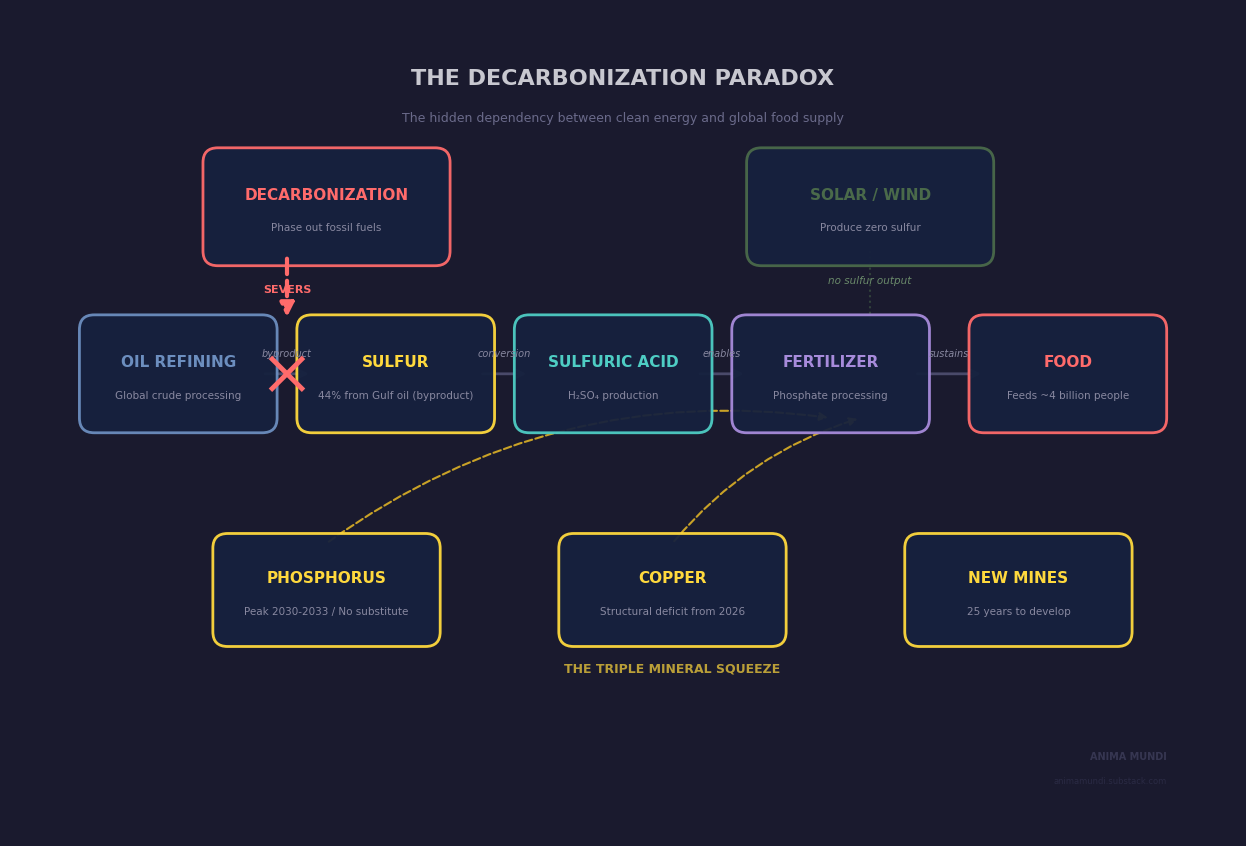
To make phosphate fertilizer, you need to process phosphate rock. And to process phosphate rock at any meaningful scale, you need sulfuric acid. Enormous quantities of it. Sulfuric acid is, by volume, the most produced industrial chemical on Earth - roughly 260 million tonnes per year - not because anyone particularly wants sulfuric acid, but because it is the universal solvent of industrial civilization. It is the thing that makes other things possible. A country’s sulfuric acid consumption used to be considered a reliable proxy for its level of industrialization. The correlation held for over a century.
Now here is the part that should make your stomach drop.
Where does sulfur come from?
The Byproduct Economy
There is a concept in industrial ecology called “co-production” - the idea that many of the materials civilization depends on are not primary products but side effects of other processes. We don’t mine sulfur because we want sulfur. We get sulfur because we refine oil and gas, and sulfur is what gets scraped out during desulfurization - the process mandated by environmental regulations to make gasoline and diesel burn cleaner.
The irony is almost too perfect. We clean up fossil fuels, and the chemical residue of that cleaning is what enables us to grow food.
Let me give you the numbers, because the numbers matter.
Forty-four percent of all seaborne sulfur originates from a single source: oil refining in the Persian Gulf. Globally, recovered sulfur from oil and gas processing accounts for roughly 90% of all sulfur production. The Claus process - the standard method for extracting sulfur from hydrogen sulfide in sour gas and refinery streams - produces about 70 million tonnes of elemental sulfur per year. This is not an ancillary flow. This is the foundation of the phosphate fertilizer industry.
And the concentration is staggering. Five countries control about 60% of recovered sulfur production. Saudi Arabia, the UAE, Qatar, Canada (from oil sands), and Russia. The geopolitics here mirror the geopolitics of oil itself - because the sulfur IS the oil, in a metabolic sense. You cannot have one without the other.
Now hold that in your mind. Let it settle.
Oil refining produces sulfur as waste. That waste becomes sulfuric acid. That acid processes phosphate rock into fertilizer. That fertilizer feeds roughly four billion people.
And now we are dismantling oil refining.
What I’m Calling “Metabolic Blindness”
There is a phenomenon I’ve been thinking about for which I cannot find a name, so I’ll coin one: metabolic blindness. It is the inability to see the full downstream consequences of changing a system’s inputs, because you are focused only on the output you care about.
Climate discourse suffers from a severe case of metabolic blindness. The conversation is structured around a single variable: carbon emissions. Reduce emissions. Hit net zero. Deploy renewables. Electrify everything. And within that frame, the logic is impeccable. Solar and wind are cheaper than coal and gas in most of the world. Battery costs are falling on learning curves that would make Moore blush. EVs are scaling. The curve bends toward decarbonization.
But carbon is not the only thing that flows through the fossil fuel system.
The fossil fuel system is not just an energy system. It is a CHEMICAL system. It produces energy, yes. But it also produces sulfur, ammonia feedstocks, petroleum coke, asphalt, lubricants, naphtha for plastics, waxes, aromatics for pharmaceuticals, and dozens of other co-products and byproducts that the rest of industrial civilization depends on. A single barrel of crude oil yields not one product but a cascade of twenty or more, each feeding different industrial supply chains that evolved around the assumption of perpetual availability.
Solar panels do not produce sulfur. Wind turbines do not produce sulfur. Nuclear reactors do not produce sulfur. None of the replacement energy sources produce the chemical byproducts that the current system generates as waste.
This is not a flaw in renewable energy. It is a flaw in our THINKING about the transition. We have modeled it as an energy swap when it is actually a metabolic transformation - one that eliminates not just the energy output of fossil fuels, but the entire chemical ecosystem that rides alongside it.
I went looking for this in the major transition models - the IEA’s Net Zero by 2050, the IRENA scenarios, the IPCC pathways. In none of them could I find a systematic accounting of co-product loss. The models track energy, emissions, and investment. They do not track the metabolic ripple effects of removing the substrate on which dozens of critical industries depend. It is as if someone modeled the effects of draining a river by counting only the water, without noticing the fish, the irrigation, the shipping, or the floodplain agriculture.
The Phosphorus Clock
Now layer this onto something even more unsettling.
Phosphorus - element 15, essential for DNA, ATP, cell membranes, and therefore all known life - has no substitute. Let me say that again because the implications are civilizational: phosphorus has NO substitute in agriculture. None. There is no synthetic alternative, no workaround, no clever chemistry that lets you grow food without it. Nitrogen you can pull from the air (at enormous energy cost). Potassium is relatively abundant and geographically distributed. Phosphorus you dig out of the ground, and when it’s gone, it’s gone.
The world mines about 220 million tonnes of phosphate rock per year. Global phosphate rock production is expected to peak somewhere between 2030 and 2033. Not because we will run out entirely - there are reserves for perhaps another century at current extraction rates - but because the easily accessible, high-grade deposits are being depleted. What remains is lower grade, more contaminated (often with cadmium, uranium, and heavy metals that require additional processing to remove), and more energy-intensive to extract.
And here’s the part that connects back to the sulfur story: lower-grade phosphate rock requires MORE sulfuric acid per tonne of usable phosphate. The acid demand per unit of fertilizer output is increasing at precisely the moment the sulfur supply is being structurally undermined.
The geographic concentration compounds the risk. Three countries - Morocco (including occupied Western Sahara), China, and Russia - control over 70% of known phosphate reserves. Morocco alone holds roughly 70% of the world’s total. The geopolitical fragility this creates is difficult to overstate. A single political disruption in Morocco could send phosphate prices into a spiral that makes the 2008 food crisis look like a market correction. In 2008, phosphate rock prices spiked 800% in eighteen months. Thirty-three countries experienced food riots.
That was with the sulfur supply chain intact.
The Triple Mineral Squeeze
I’ve been calling this the Triple Mineral Squeeze, because it is not just sulfur and phosphorus. There is a third jaw in this trap.
Copper.
Every solar panel needs copper. Every wind turbine needs copper. Every electric vehicle needs three to four times more copper than a combustion engine vehicle. Every meter of grid infrastructure that connects these new energy sources needs copper. The International Energy Agency, the World Bank, S&P Global, and independent researchers like Michaux all converge on the same conclusion: the energy transition requires a massive, unprecedented scaling of copper production at precisely the moment when copper is entering structural deficit.
The numbers are sobering. Average copper ore grades have fallen below 0.7%. A century ago, miners were pulling 2-3% ore out of the ground. This means you now need to move roughly three to four times more rock to extract the same amount of metal. Energy per tonne of refined copper is rising. Water consumption per tonne is rising. Tailings volume per tonne is rising. The environmental footprint of copper mining is expanding even as the output per unit of effort contracts.
The projected shortfall is staggering. S&P Global’s January 2026 assessment projects a potential 19 million metric ton shortfall by 2050, with AI infrastructure and defense spending adding NEW demand on top of the energy transition requirements. The UN warned in May 2025 that copper shortages risk slowing the entire energy transition.
And here is the temporal trap: new copper mines take approximately 25 years to develop, from discovery through geological assessment, permitting, environmental review, legal challenges, construction, and ramp-up to full production. Twenty-five years. The mines that would need to be producing copper for the 2040 transition targets should have started development in 2015. They did not. The ones that would serve 2050 targets should be breaking ground right now. Most are not. The permitting environment in most developed countries has gotten MORE restrictive, not less. The average time to permit a mine in the United States now exceeds seven years, and that’s before a single shovel breaks ground.
So we have a situation where:
Decarbonization removes the sulfur supply chain that fertilizer production depends on
Phosphorus deposits are degrading, requiring MORE sulfuric acid per tonne of output
Copper - essential for building the replacement energy system itself - is entering structural deficit
The timeline to develop new mineral sources exceeds the timeline of the transition itself
The geographic concentration of all three resources creates compounding geopolitical fragility
This is not a policy problem. This is a thermodynamic problem. And thermodynamics does not negotiate.
The Speed Paradox
Here is where the paradox becomes truly vertiginous.
If we decarbonize slowly, we fail to address climate change in time. The warming continues, the feedback loops accelerate, the costs compound. The IPCC’s remaining carbon budget for 1.5C is, depending on the estimate, somewhere between already exhausted and a decade away from exhaustion. Slow is not an option.
If we decarbonize quickly - which is what the science demands and the activists call for and the engineers are trying to build - we SIMULTANEOUSLY destabilize the food system by removing the sulfur supply chain, while demanding quantities of minerals that do not exist in accessible form within the required timeframe.
The faster we move, the harder the squeeze. The slower we move, the worse the climate outcome. There is no speed of transition that avoids both hazards simultaneously.
I keep looking for the flaw in this logic. I keep hoping someone will point to the error, the missing variable, the technological solution I’ve overlooked. And there are partial answers - I want to be honest about that. Sulfur can be mined directly from volcanic deposits and native sulfur sources, but these represent a tiny fraction of current recovered volumes. Phosphorus can be recovered from wastewater and manure, but the economics and scaling challenges are severe - current recovery rates capture perhaps 10-15% of phosphorus in waste streams. Copper can be recycled more aggressively, and deep-sea mining could theoretically access new reserves, but deep-sea mining faces enormous ecological and regulatory barriers and is at least a decade from commercial scale.
Partial answers at the margin do not resolve a structural contradiction at the foundation. The question is not whether these alternatives exist. The question is whether they can scale to replace the BYPRODUCT volumes of a global fossil fuel system that processes roughly 100 million barrels of oil per day. When you run the numbers - and I mean actually run them, barrel by barrel, tonne by tonne - the answer is sobering.
The Silo Problem
I’ve spent months now reading everything I can find at the intersection of mineral constraints and energy transition planning. What strikes me is not the absence of research. Michaux’s work at GTK is rigorous and publicly available. Dana Cordell’s peak phosphorus research has been published since 2009. The copper deficit projections come from the ICSG, the World Bank, and S&P Global - mainstream institutions with no ideological axe to grind. The sulfur dependency is well-documented in the fertilizer industry literature. The information exists.
What strikes me is the absence of SYNTHESIS.
The phosphorus people talk to the phosphorus people. The copper people talk to the copper people. The energy modelers model energy. The agricultural scientists model agriculture. The fertilizer industry tracks sulfur supply with great precision but does not connect it to decarbonization scenarios. The climate modelers track carbon with extraordinary sophistication but do not model co-product loss from reduced refinery throughput. And between these silos, in the negative space where the dependencies live, nobody is standing.
This is a failure of institutional architecture, not individual intelligence. Our research funding, our academic departments, our policy agencies, our international organizations - they are all structured around disciplinary boundaries that mirror the structure of 20th-century industry. Energy in one box. Agriculture in another. Mining in a third. Finance in a fourth. But the dependencies don’t respect those boundaries. Sulfur doesn’t care which department studies it. Phosphorus doesn’t wait for interdisciplinary funding to be approved.
The climate conversation has become so polarized - so organized around the binary of “believe the science” versus “deny the science” - that there is almost no room for a third position: believe the science AND recognize that the proposed solutions contain structural contradictions that science itself reveals.
This is not climate denial. This is climate DEPTH. It is the insistence that we look at the full system - not just the atmospheric carbon layer, but the lithospheric layer, the agricultural layer, the chemical layer, the temporal layer, the geopolitical layer. It is the refusal to simplify a civilizational transformation into a PowerPoint slide with two curves crossing.
The Historical Pattern
This is not the first time a civilization has restructured its metabolic base without understanding the consequences.
When Europe transitioned from wood to coal in the 18th and 19th centuries, the immediate benefits were obvious - more energy, faster growth, urban expansion. What was invisible was the way coal restructured everything: where people lived (near mines and rail lines), how they organized labor (factories instead of workshops), what they ate (industrial agriculture became possible at scale), how they governed (centralized states capable of managing industrial infrastructure). The entire social, political, and economic architecture of modernity was shaped not by ideology but by the metabolic requirements of a coal-based civilization.
The transition from coal to oil in the 20th century repeated the pattern. Oil didn’t just replace coal’s energy. It created the suburb, the commuter, the global supply chain, the petrochemical industry, the Green Revolution, the geopolitics of the Middle East, and the atmospheric chemistry that is now forcing the next transition. Each of these was a downstream metabolic consequence that no one planned and few understood in real time.
We are now attempting the third great metabolic transition - from fossil fuels to renewables - and we are making the same mistake again. We are modeling the energy and ignoring the metabolism. We are counting the calories and ignoring the nutrients.
What This Means
If you are reading this and you work in energy, agriculture, mining, or policy - please understand that I am not arguing against decarbonization. The climate crisis is real, the science is unambiguous, the need to transition is urgent. I am not offering ammunition for fossil fuel interests, and I’ll be blunt: anyone who uses this analysis to argue for slowing the transition is misreading it. The climate math doesn’t allow for delay.
What I am arguing is that the transition, as currently conceived, contains a hidden fragility that could produce a food crisis of unprecedented scale if it is not addressed with the same urgency and rigor we bring to emissions reduction.
We need, desperately, a new field of integrated study. Call it transition metabolism, or systemic decarbonization, or cross-domain transition science - whatever name sticks. It needs to map the full web of material dependencies across the fossil fuel system and develop strategies for each co-product that will be lost as refinery throughput declines. It needs to bring the sulfur people and the solar people and the phosphorus people and the copper people and the food systems people into the same room and keep them there until they’ve built integrated models that capture what the siloed ones miss.
We need this field to exist BEFORE the sulfur supply tightens, not after. Before the phosphate prices spike, not after. Before the copper deficit bites, not after. The lag times in mineral development mean that the decisions we fail to make in the next five to ten years will determine whether the transition of the 2030s and 2040s is managed or catastrophic.
And we need something harder than new institutions. We need a new kind of honesty in climate discourse - one that can hold two truths simultaneously: the transition is necessary AND the transition is more dangerous than we have been told. Not because the destination is wrong, but because the map we are using to get there is missing critical terrain.
Sitting With the Paradox
Friend, I realize this letter is heavier than most. I realize I’ve given you a problem without a clean solution, a diagnosis without a neat prescription. That’s intentional.
I’ve become convinced that the most dangerous thing in the world right now is not ignorance. It is false clarity. The feeling that we know what to do, that the path is obvious, that it is just a matter of political will and capital deployment. False clarity feels good. It gives you something to march behind. But it can walk you off a cliff while you’re busy feeling righteous about the direction.
The path is not obvious. The entanglements are deeper than we’ve been told. And the only way through is to face the full complexity with open eyes, even when - especially when - it makes us uncomfortable.
I keep coming back to something the systems theorist Donella Meadows wrote: “The system always kicks back.” She meant that complex systems resist simple interventions because the interventions trigger secondary effects that counteract the original intention. She wasn’t arguing against intervention. She was arguing for HUMILITY in intervention - for the kind of deep systems understanding that lets you anticipate the kickback before it hits.
Climate policy is kicking back. Not through political resistance or market failure, but through the brute physics of material dependency. The sulfur-phosphorus-copper nexus is the system kicking back at a transition that was modeled in two dimensions when reality operates in twenty.
I’ll be writing more about this in the coming weeks. There are threads here that lead into phosphorus geopolitics, the thermodynamics of mineral processing, the history of civilizational metabolic transitions, and ultimately into questions about what kind of civilization is possible on the other side of this bottleneck. These are the questions that Heliogenesis - the project I’m building with a growing number of researchers and practitioners - is designed to address. Not with false clarity, but with the kind of integrated, cross-domain thinking that the situation demands.
For now, I wanted to lay the foundation. To name the paradox. To make the invisible chain visible.
Because the first step in solving a problem is admitting that the problem is more complex than the story we’ve been telling ourselves.
Until next time.
M.
If this piece resonated, share it with someone who works at the intersection of energy and agriculture. These conversations need to happen across silos, not within them.
For further reading: Simon Michaux’s mineral assessment reports at GTK Finland; Dana Cordell and Stuart White’s work on peak phosphorus (2009-present); S&P Global’s 2026 copper supply assessment; Vaclav Smil’s work on material flows in civilization, particularly “Making the Modern World” (2013) and “How the World Really Works” (2022); Donella Meadows, “Thinking in Systems” (2008).