The Fermentation Principle
Why some things cannot be rushed, and what we lose when we try

In the kitchen of a house where I once lived in the Azores, there was a ceramic crock that sat on a shelf for the entire year I was there. Inside it, something was slowly becoming something else. The woman who owned the house checked it occasionally lifting the lid, smelling, sometimes stirring but mostly she left it alone. When I asked what it was, she said: It’s not ready to be named yet.
I think about that crock often. Not because I ever learned what was in it I left before it was finished but because of what it represented: a relationship to time and transformation that I had almost entirely lost and am still trying to recover.
The principle I want to explore in this essay is simple to state but difficult to embody. It is the principle that underlies fermentation: that some transformations cannot be rushed, that the most valuable things often emerge through slow processes we do not fully control, and that modern culture’s hostility to waiting is not merely an inconvenience but a fundamental error about how value is created.
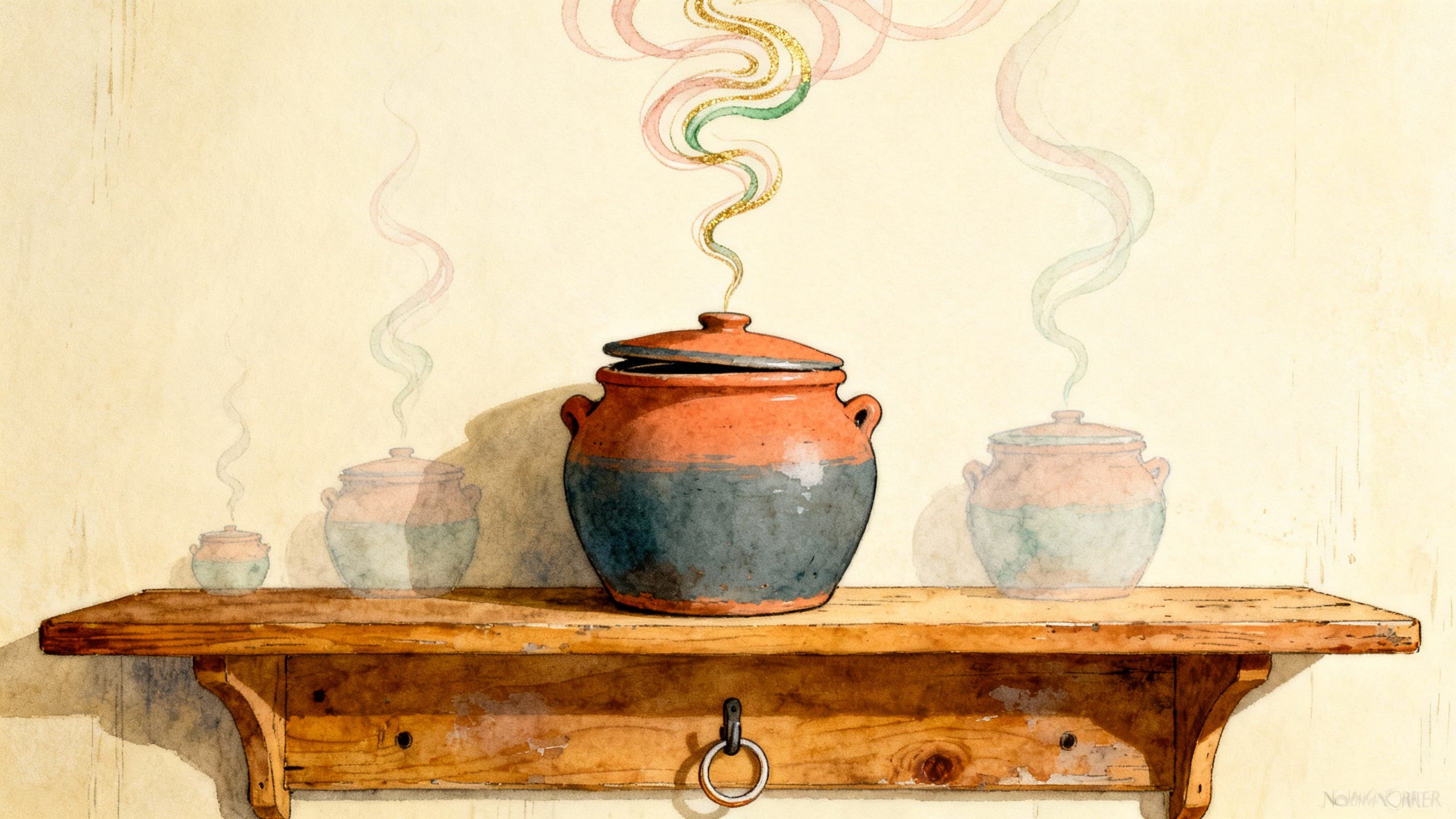
Fermentation is, technically, a metabolic process by which microorganisms convert carbohydrates into alcohols or acids. But this technical definition obscures something more fundamental about what fermentation actually is: controlled decomposition under specific conditions, where time and microbial activity transform base materials into something more complex, more valuable, and more alive.
Consider what happens when you make wine. You begin with grape juice sweet, simple, perishable. Left alone, it would rot. But placed in the right vessel, at the right temperature, with the right yeasts present, something else happens. The sugars are consumed. Alcohol is produced. Flavor compounds develop. Over months or years, the liquid transforms into something that the original grape juice could never have been: complex, stable, capable of improving with additional time.
The winemaker does not make this happen. The winemaker creates the conditions under which it can happen and then waits. The transformation is done by agents the winemaker does not fully understand or control—wild yeasts, bacteria, chemical reactions too complex to model completely. The winemaker’s art is not manufacturing but midwifery: knowing what conditions to establish, when to intervene, and when to leave things alone.
This is the fermentation principle: that some transformations require the combination of appropriate conditions, uncontrolled agents, and time. Remove any of these three elements and you do not get fermentation. You get either stasis or rot.
I want to suggest that this principle applies far beyond the kitchen. That it is, in fact, a general law of value creation that we have systematically violated in our rush toward optimization.
Ideas. The best thinking I have ever done did not happen when I was trying to think. It happened in the gaps between thinking during walks, in the shower, in the middle of the night, during years when a problem sat at the back of my mind, slowly composting. The insight, when it came, felt less like invention than like discovery: something had been growing in the dark, and I merely noticed when it finally broke the surface.
This is not mysticism. It is how cognition actually works. The brain continues processing problems when we are not consciously attending to them. Connections form, patterns emerge, solutions crystallize but only if we give them time, only if we resist the urge to force resolution. An idea that is rushed to publication is like wine bottled too early: it may be drinkable, but it will never develop the complexity it could have achieved.
Relationships. There is no way to accelerate genuine intimacy. You cannot optimize your way to trust. The couples I know who have achieved something durable did so not through intensity but through accumulation thousands of small moments, many of them boring, slowly composting into something that could not have been constructed directly. The relationships that began with instant connection, with the feeling that everything was already understood, often proved to be the most fragile. They had skipped the fermentation and mistaken the initial sweetness for the finished product.
Organizations. Every startup founder has been told to scale fast, to grow before the competition catches up, to prioritize speed above all else. Some of this advice is sound. But the organizations that last the ones that develop genuine culture, that inspire loyalty, that survive the departure of their founders are almost always organizations that were allowed to ferment. They developed slowly enough that norms could emerge organically, that trust could build through repeated interaction, that the organization’s identity could become something more than a mission statement.
Premature scaling is to organizations what pasteurization is to cheese: it may be safer and more predictable, but it kills the living cultures that would have made the thing interesting. A company that grows too fast is a company that never develops a soul.
The modern economy is essentially anti-fermentative. Its basic logic is to eliminate waiting, to remove uncontrolled variables, to optimize processes until they produce maximum output in minimum time.
This makes sense for manufacturing. If you are producing identical units of a commodity, faster is better, and standardization is a virtue. The factory is the perfection of anti-fermentative logic: every variable controlled, every process timed, every output predictable.
But we have made the mistake of applying factory logic to domains where it does not belong domains where the fermentation principle is actually operative. We have tried to manufacture education, therapy, art, community, meaning. And we are surprised when the results are flat, when they lack the complexity and depth that we somehow expected.
Consider modern therapy. The dominant models are explicitly anti-fermentative. Cognitive behavioral therapy aims to identify problematic thoughts and replace them with better ones quickly, efficiently, measurably. The goal is to process trauma, to work through grief, to resolve psychological conflicts in a defined number of sessions. Insurance companies prefer therapies that promise results on a timeline.
I do not doubt that these approaches help people. But I wonder what is lost when we treat the psyche like a factory floor, when we try to optimize grief rather than allowing it to ferment. The people I know who have been genuinely transformed by suffering who have emerged not just recovered but deeper, wiser, more capable of compassion did not process their pain efficiently. They lived with it for years. They let it compost. They did not know what they were becoming until they had already become it.
There is a difference between trauma that has been processed and trauma that has been fermented. Processed trauma has been neutralized, defused, made manageable. Fermented trauma has been transformed composted into something that feeds new growth. The first is relief. The second is wisdom. We have optimized for the first and wonder why the second is so rare.
What are the conditions for fermentation? If we take the principle seriously, we should be able to specify what makes transformation possible not to control it, which would defeat the purpose, but to create environments where it is more likely to occur.
The right container. Fermentation requires boundaries. Wine needs a barrel; sourdough needs a crock; kimchi needs a jar. Without containment, the process dissipates. The boundaries are not arbitrary their material, their porosity, their size all affect the outcome but some boundary is necessary. For ideas, the container might be a question that holds your attention, a problem you keep returning to. For relationships, it might be commitment not as constraint but as the vessel that allows intimacy to develop. For organizations, it might be shared purpose, a bounded identity that lets culture accumulate.
The right temperature. Too cold and nothing happens; too hot and you kill the microbes or accelerate decomposition into rot. Every fermentation has a temperature range within which transformation is possible. For ideas, this might be the level of attention enough engagement to keep the problem alive, not so much that you force a premature solution. For grief, it might be the balance between feeling the pain and being overwhelmed by it. For organizations, it might be the pace of growth fast enough to maintain momentum, slow enough to let culture develop.
The right starter culture. Fermentation is done by living agents yeasts, bacteria, molds that transform the substrate. You can let wild cultures colonize your ferment, or you can introduce specific strains, but either way, you need living agents doing work you cannot do yourself. For ideas, these might be other thinkers, books, conversations influences that you invite into your mental ferment. For relationships, they might be shared experiences, mutual friends, challenges faced together. For organizations, they are the early employees whose values and habits become the culture’s starter.
Time. There is no substitute for this. No technology, no technique, no amount of resources can compress certain transformations below their natural duration. You can create perfect conditions and still have to wait. This is perhaps the hardest element for modern consciousness to accept—that waiting is not inefficiency but necessity, that some valuable things take exactly as long as they take.
I want to be careful here not to romanticize slowness for its own sake. Not everything should ferment. Some problems should be solved quickly. Some decisions should be made efficiently. The factory has its place.
The error is not speed itself but the failure to distinguish between domains where speed is appropriate and domains where it is destructive. We have applied factory logic universally, and we are paying the price in flatness, in meaninglessness, in the strange modern affliction of having everything we want and wanting none of it.
The things that matter most genuine understanding, durable relationships, work that means something, institutions that last, selves that have depth are almost all fermented rather than manufactured. They emerge from processes that cannot be fully controlled or accelerated. They require us to create conditions, introduce cultures, maintain temperatures, and then wait.
This is, perhaps, the deepest challenge the fermentation principle poses to modern consciousness: the requirement that we tolerate uncertainty. When you put grapes in a barrel, you do not know exactly what will emerge. You can influence the process, but you cannot determine the outcome. This is true of ideas, relationships, organizations, selves. If you need to know in advance what something will become, you cannot ferment it. You can only manufacture it and manufactured things, however perfect, are never quite alive.
There is an ecological dimension to this that connects to the earlier essays in this series.
The global carbon cycle is, fundamentally, a fermentation process operating at planetary scale. Carbon is captured by plants, consumed by animals, returned to soil, decomposed by microbes, slowly transformed over millions of years into fossil deposits. This is fermentation’s time signature: deep, slow, patient. The carbon that becomes coal or oil is carbon that has been fermenting for epochs.
When we extract and burn fossil fuels, we are interrupting a fermentation. We are taking material out of its slow transformation and releasing its energy all at once the planetary equivalent of opening a wine barrel after one week and drinking what’s inside. It might give you a buzz, but it’s not wine. And you’ve lost what it would have become.
The climate crisis, from this angle, is a crisis of temporal mismatch. We are consuming at industrial speed what was produced at fermentation speed. We have broken the cycle by refusing to wait by treating the planet’s slow-fermented energy reserves as if they were fast-manufactured commodities.
The restoration of a viable relationship to Earth may require, among other things, relearning how to ferment. How to work with slow processes. How to create conditions and wait. How to participate in cycles rather than interrupting them.
I return to the crock in the Azores, the thing that was not yet ready to be named.
What struck me about the woman who tended it was her patience, but also her confidence. She was not anxious about the outcome. She did not check it obsessively. She had created the conditions, introduced the cultures, and now she was waiting not passively, but attentively. She knew that her job was not to make something happen but to let something happen, to be present to the process without controlling it.
This is, I think, the disposition that the fermentation principle asks of us. Not passivity fermentation requires care, attention, skilled intervention at the right moments. But a kind of active patience, a willingness to participate in processes we do not fully control, to tolerate the uncertainty of not knowing what will emerge, to trust that something is happening even when we cannot see it.
We live in an age that has optimized almost everything and fermented almost nothing. We have manufactured a world of unprecedented abundance and unprecedented emptiness. The path forward may require recovering the ancient knowledge that the woman in the Azores never lost: that the best things are not made but grown, not forced but tended, not optimized but allowed.
Some things cannot be rushed. This is not a limitation. It is the very condition of their value.
This is the fourth in a series of essays I’m releasing in the early weeks of this year. These pieces have, themselves, been fermenting—some for months, some for years. Thank you for receiving them.
— M.