The Four Withdrawals
Anima Mundi — February 2026

Dear friends,
I’ve been sitting with the news this week the way you sit with a headache that won’t declare itself. Not sharp enough to demand attention, not mild enough to ignore. Something is off. Something has been off. And I’ve been trying to name it.
Here’s what I keep coming back to: we are living through a series of quiet withdrawals. Not collapses—that would be too dramatic, too cinematic. Withdrawals. The slow pulling back of attention, commitment, presence. The civilizational equivalent of ghosting.
Let me tell you what I noticed this past week.
I. The Grid Beneath Your Feet
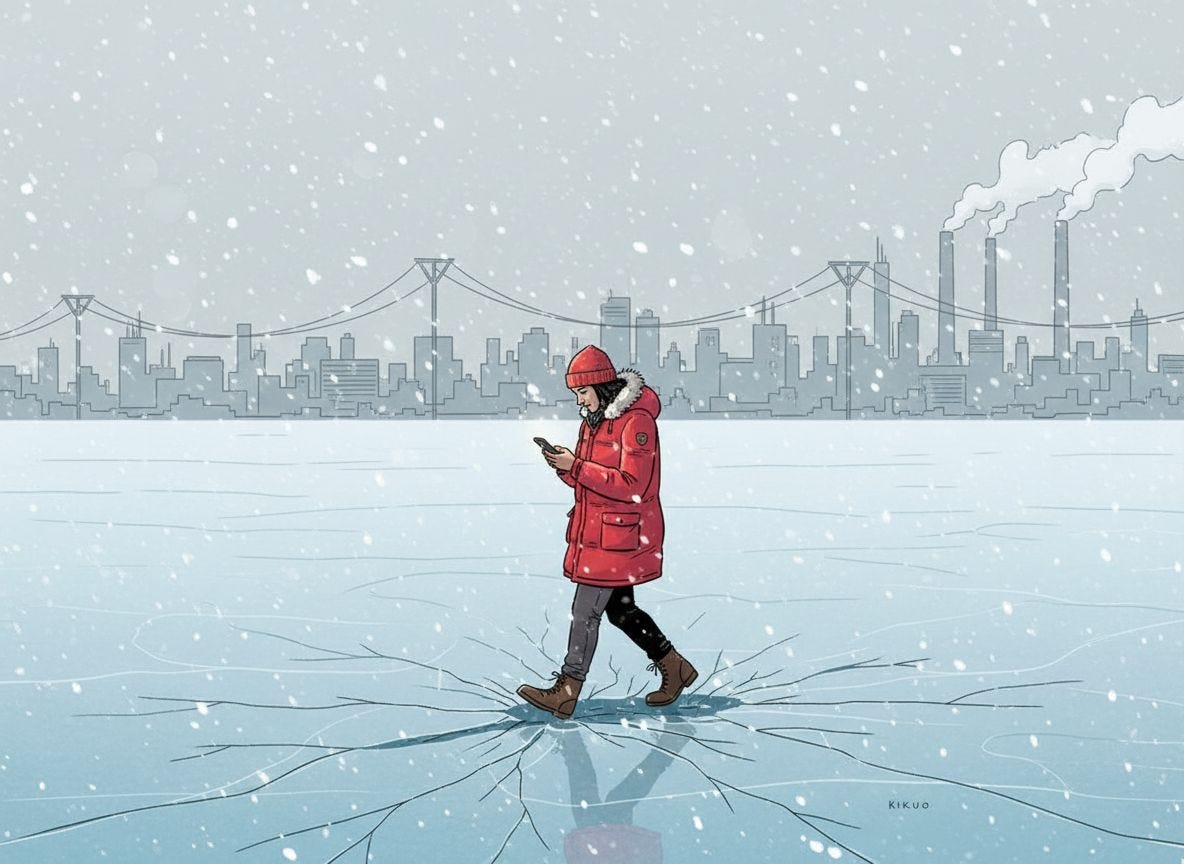
You probably heard about Winter Storm Fern. Maybe you didn’t—it wasn’t one of those storms that dominates the news cycle for weeks. It swept across 2,300 miles of the United States from January 21st to the 28th, left over a million people without power, killed at least fifty people, including three brothers in Texas who fell through ice on a pond while trying to collect water because their pipes had frozen.
Three brothers. Falling through thin ice. In 2026.
What struck me wasn’t the storm itself—we’ve had storms before, we’ll have them again. What struck me was what the storm revealed about what we’ve built. Or rather, what we’ve stopped maintaining.
Here’s a fact that didn’t make many headlines: during the storm, wholesale electricity prices in parts of the PJM grid—that’s the network serving 65 million people across the mid-Atlantic and Midwest—surged from around $200 per megawatt-hour to over $3,000. A fifteen-fold increase. In a matter of hours.
Why? Because we’ve built an energy system that runs on just-in-time delivery.
Natural gas now provides roughly 40% of America’s electricity—up from about 12% in 1990. In three decades, we’ve completely restructured our energy metabolism. And gas plants, unlike the coal plants they replaced, mostly don’t store fuel on-site. They depend on pipelines delivering gas exactly when they need it. The fuel arrives moments before it’s burned.
This works beautifully—until it doesn’t. Until a cold snap freezes wellheads in Texas. Until demand spikes everywhere at once and there isn’t enough supply. Until the system designed for efficiency discovers it has no slack, no buffer, no margin for error.
We traded resilience for efficiency without quite noticing the exchange.
I think about this a lot: the invisible infrastructure of daily life. The assumption that when I flip a switch, light happens. When I turn a tap, water flows. These aren’t natural phenomena. They’re the product of systems so complex that no single person understands them fully, maintained by institutions whose funding we’ve been quietly cutting for decades, dependent on supply chains that stretch across continents and assume cooperation between strangers who will never meet.
And here’s the second-order effect no one talks about: every time the grid fails, trust erodes a little more. People buy generators. They hoard fuel. They start thinking of themselves as separate from the system rather than part of it. The failure creates the conditions for the next failure.
The third-order effect is darker still: the people who can afford backup systems pull out of the commons. The wealthy get solar panels and batteries and whole-house generators. The poor get candles and space heaters and house fires. The infrastructure that’s supposed to bind us together becomes another mechanism of separation.
There’s a word for this in systems thinking: cascading failure. But I prefer an older word: abandonment.
We’ve abandoned the grid. Not officially—no one made a speech about it. We just stopped treating maintenance as a priority. We chose tax cuts over infrastructure bills. We chose quarterly returns over generational investment. We chose now over later until later arrived.
The three brothers falling through ice—that’s what later looks like.
II. The Heat We Can’t See
While the storm was freezing the eastern United States, scientists published their annual assessment of ocean heat content. The news was exactly what you’d expect, which is perhaps why it barely made a ripple.
The oceans absorbed a record-setting 23 zettajoules more energy in 2025 than in 2024. This was the ninth consecutive year of record ocean heat. Let me put that number in perspective: 23 zettajoules is roughly 37 times humanity’s entire annual energy consumption. Or about 210 times global electricity generation. The heat we added to the oceans last year is equivalent to more than two centuries of human power usage, just... absorbed. Stored. Waiting.
“It’s a huge engine, the ocean,” one oceanographer told reporters, “and we are just filling it up with energy.”
I want to pause on this because I think we’ve become numb to climate statistics. We hear “record heat” and our eyes glaze over. We’ve heard it too many times. The alarm has been ringing so long it’s become background noise. The first alarm is around a hundred years ago or even longer than that.
But here’s what makes the ocean different from the atmosphere: the ocean remembers. Surface temperatures fluctuate year to year—one cool summer and the skeptics come out to announce that global warming was a hoax. But ocean heat content is cumulative. It only goes one direction. And 90% of the excess heat from greenhouse gases ends up there, not in the air we measure for weather reports.
The ocean is the true ledger of what we’ve done. The atmosphere lies; the ocean tells the truth.
And here’s the thing about stored heat: it doesn’t stay stored forever. Eventually it releases. It drives hurricanes that linger longer over coastlines because the water beneath them is warmer than it used to be. It melts ice from below. It changes circulation patterns in ways we’re only beginning to understand. The heat we added decades ago is still working its way through the system.
We’ve been taking out loans against the future and pretending they don’t have to be repaid. The ocean is the bank that holds our debt. And the interest is compounding.
What’s the second-order effect? I think it’s psychological, not physical. It’s the slow erosion of the assumption that the world we knew will continue. My parents grew up expecting the beaches of their childhood to be there for their grandchildren. My generation is less sure. The generation now being born—what will they expect? What does it do to a psyche to grow up knowing the maps are temporary?
The third-order effect is political. When people stop believing in a stable future, they stop sacrificing for it. Why invest in infrastructure that might be underwater? Why have children who’ll inherit a degraded world? The despair feeds the withdrawal, and the withdrawal accelerates the degradation. Another loop, closing.
III. The Exit from the World
On January 27th, the United States officially withdrew from the Paris Agreement for the second time.
I want to be careful here because this isn’t a political newsletter and I don’t want to make it one. Whatever your views on climate policy or American politics or the proper role of international agreements, something happened that week that deserves attention.
It wasn’t just the Paris Agreement. In the same period, the administration announced withdrawal from the UN Framework Convention on Climate Change—the underlying treaty that Paris was built upon. And from more than 60 other multilateral organizations covering environment, peace, gender equality, and democracy.
More than 60 organizations. In one executive action.
The United States now joins Iran, Libya, and Yemen as the only nations on Earth not party to the Paris Agreement. That’s the company. Those are the peers.
But here’s what haunts me: it happened quietly. There were no massive protests. The markets didn’t crash. No one seemed particularly surprised. We’ve become so accustomed to withdrawal that withdrawal itself has become normal. The Overton window has shifted so far that stepping back from the world no longer registers as remarkable.
I remember the first withdrawal, in 2017. There was outrage. Marches. Mayors and governors pledging to uphold the agreement on their own. There was a sense that something unprecedented and terrible had happened, that the nation was breaking a sacred commitment to the future of life on Earth.
This time? A shrug. Some headlines. On to the next thing.
What’s the second-order effect? I think it’s the loss of the capacity for coordination, not just the loss of one agreement. International cooperation is a muscle. You have to exercise it or it atrophies. Every time a nation steps back from the table, every time commitments are broken without consequence, the muscle weakens. Other nations notice. Trust erodes. The next agreement becomes harder to reach, the next crisis harder to address collectively.
Climate change is not a problem that any nation can solve alone. Neither is pandemic preparedness, or AI safety, or nuclear proliferation. We’ve built a world where the threats are global but the responses are fragmenting into nationalist silos.
The third-order effect is what happens when the remaining nations draw the obvious conclusion: America is not a reliable partner. Deals made with this administration may not survive the next. Why negotiate with a country that treats treaties as temporary? The vacuum creates space for other powers to step in, other arrangements to form, other centers of gravity to emerge. We may be watching the slow-motion transfer of global leadership in real time, dressed up as “sovereignty” and “putting our country first.”
But what struck me most was the list: more than 60 organizations. Environment. Peace. Gender equality. Democracy. These aren’t random categories. They’re the infrastructure of cooperation itself—the institutional memory of how to work together across borders. Withdrawing from them isn’t just policy disagreement. It’s something closer to civilizational amnesia.
We’re choosing to forget how to coordinate.
IV. The Great Withdrawal
Now I want to tell you about the numbers that keep me up at night.
Taiwan now has the lowest birth rate in the world: 4.62 births per 1,000 people, which translates to a total fertility rate of approximately 0.8 children per woman. South Korea, the previous record-holder, is close behind. China recorded its lowest birth rate on record in 2025, as its population shrank for the fourth consecutive year.
In the United States, the Congressional Budget Office projects that fertility will continue falling through 2036, with population growth declining to zero by 2056 and then reversing. We are projected to begin shrinking within three decades.
And here’s the data point that connects all of this: the 2026 Edelman Trust Barometer, released in January, found that 70% of people globally are now unwilling or hesitant to trust someone with different values, backgrounds, information sources, or approaches to problems. Seven in ten. Across income levels, across genders, across age groups, across developed and developing nations.
The report’s authors have a name for what we’re experiencing: insularity. They describe a five-year trajectory: fear → polarization → grievance → insularity. We’ve moved from being afraid to being angry to feeling victimized to... withdrawing. Pulling back into smaller and smaller circles of trust. Retreating from strangers, from difference, from the effort of understanding anyone who isn’t already like us.
Only 32% of people globally now believe the next generation will be better off. In France, it’s 6%. In Germany, 8%. In the US, 21%.
This is the psychological foundation beneath everything else I’ve described. The grid failures, the ocean heating, the international withdrawals—they’re not happening in a vacuum. They’re happening to people who are already exhausted, already grieving, already pulled inward.
Here’s how I understand it: we’re withdrawing from continuation itself. Not just from Paris agreements or infrastructure maintenance—from the basic project of keeping civilization going. It shows up in falling birth rates. It shows up in people who no longer believe their children will inherit a world worth living in. It shows up in the trust data: when seven in ten people can’t extend basic trust to anyone different from themselves, how do you build anything that requires cooperation across difference? How do you maintain a grid, negotiate a treaty, or raise a child in a society of strangers?
The second-order effect is institutional. More than 40 colleges have closed in the United States since 2020, with projections of up to 80 more closing in the coming years. The “enrollment cliff”—the downstream consequence of the 2008 recession’s birth rate drop—is here. The children who weren’t born are not enrolling now. And when colleges close, communities lose cultural anchors, economic engines, gathering places for people who would otherwise never meet. Another erosion of the connective tissue.
The third-order effect is demographic and political. A society that stops reproducing itself has to import the next generation or accept decline. But the same insularity that produces low fertility also produces hostility to immigration. The same trust collapse that makes people unable to imagine a shared future makes them unable to welcome strangers who might help build one. We are caught in a trap of our own making.
What Does It Mean?
I’ve been turning these four stories over in my mind for days now, and here’s what I keep coming back to:
These aren’t separate crises. They’re the same crisis wearing different masks. The grid, the oceans, the treaties, the birth rates—they all require the same thing: commitment to continuation. Investment in futures we won’t live to see. Trust that strangers will do their part even when we can’t verify it. Faith that maintenance matters, that showing up matters, that the work of tending is worthy work.
And in all four domains, we’re withdrawing from that commitment.
Not dramatically. Not with manifestos or declarations. Just... quietly. The way you withdraw from a relationship you don’t have the courage to end. You stop calling. You stop showing up. You let entropy do the work of departure.
I think we’re experiencing something that doesn’t have a good name yet. It’s not collapse—that implies a dramatic event, a moment when everything falls. It’s more like what happens to a body when it stops maintaining itself. The systems continue functioning, mostly. But the margins narrow. The resilience shrinks. The capacity to absorb shocks diminishes. And then one day a winter storm reveals that the emperor has no clothes, the grid has no slack, the society has no depth.
There’s a concept in ecology called shifting baseline syndrome. It describes how each generation takes the degraded state of the environment they inherited as “normal.” What their grandparents would have seen as catastrophic loss, they experience as just the way things are. The baseline shifts, and with it, the sense of what’s possible.
I think we’re experiencing a civilizational version of this. The baseline of what we expect from institutions, from cooperation, from the future—it’s shifting downward. And we’re adjusting. We’re learning to expect less. We’re learning to trust less. We’re learning to withdraw.
The Question I Can’t Answer
Here’s where I should probably offer a solution. That’s the structure these essays are supposed to follow: identify the problem, offer the insight, provide the path forward. Tie it up neatly.
I can’t do that today.
What I can say is that awareness is the first step. Noticing the withdrawals. Naming them. Recognizing that the storm and the ocean and the treaty and the birth rate are connected—that they’re all symptoms of the same underlying condition.
What I can say is that every system that’s withdrawing is a system that could be reinvested in. Grids can be hardened. Trust can be rebuilt. Children can be born to people who believe in the future. None of this is physically impossible. It’s a choice. Many choices. Made by millions of people, every day.
What I can say is that the withdrawal isn’t inevitable. It feels inevitable—that’s part of its power. It presents itself as realism, as maturity, as finally seeing things clearly. But it’s a choice dressed up as fate. We can choose differently.
And maybe this is the most important thing I can say: the withdrawal happens one relationship at a time, one conversation at a time, one moment at a time. The grid is maintained—or not—by the worker who shows up to inspect the transformer. The trust is rebuilt—or not—by the person who extends themselves to someone different. The future is invested in—or not—by the parent who chooses hope over despair.
I don’t know how to fix the big systems. I’m not sure anyone does. But I know that the big systems are made of small choices, and the small choices are where we live.
A Closing
I started this letter talking about a headache—something that won’t quite declare itself. I think I’ve figured out what it is.
It’s the feeling of living in a civilization that is losing its will to continue. Not its capacity—we still have the technology, the resources, the knowledge. We could maintain the grid. We could coordinate on climate. We could invest in futures beyond our own lifetimes. We could.
But we’re choosing not to. We’re choosing withdrawal. We’re choosing the safety of the familiar over the risk of commitment. We’re shifting from “we” to “me.”
And the headache is the low-grade awareness that something is being lost. Something that might not come back.
The poet John Donne wrote, four centuries ago: “No man is an island, entire of itself; every man is a piece of the continent, a part of the main.”
I think about those words differently now than I used to. I used to read them as a moral statement—a reminder that we should care about each other. Now I read them as a description of reality. We are connected whether we like it or not. The grid that fails in Texas affects prices in New York. The heat absorbed by the Pacific drives storms in Missouri. The treaty broken in Washington weakens cooperation in Paris. The child not born in Seoul means the college not sustained in Vermont.
The connections are there. The question is whether we’re willing to honor them.
I don’t know the answer. But I know the question matters.
I know the ice is thin.
I know we’re still walking on it.
And I know that attention—genuine, sustained, uncomfortable attention—is the first step toward anything else.
So that’s what I’m offering this week. Not a solution. Not a roadmap. Just attention. Just the willingness to look at what’s happening and call it by its name.
The four withdrawals: from our infrastructure, from our planet’s boundaries, from our international commitments, from each other.
May we find the courage to reverse them. Or at least, to stop.
With love and something like hope,
Malte
If this letter moved you, I’d be grateful if you shared it with someone who might need to read it. And if you’re new here: Anima Mundi is where I think out loud about being human in a transforming world. Welcome.
Thanks for this, Malte. The framing of withdrawals feels very useful.
I especially appreciated the anchoring of the climate story in the ocean – "The ocean is the true ledger of what we’ve done. The atmosphere lies; the ocean tells the truth." I had a very clear "oh shit moment before the pandemic when I realized the role of the ocean, thanks to a climate denier actually.
Thank you Malte for this thoughtful and highly necessary text. I wholeheartedly agree with you when you say the first step is awareness: without it, entropy is anything but unavoidable. Insularity only protects us from awareness, nothing else.