The Interregnum
On the economy between worlds—where the old rules dissolve before new ones form, and the machines that replace us drink rivers dry

By Malte Wagenbach

In The Dalles, Oregon, a town of sixteen thousand along the Columbia River, there is a building you cannot photograph. It sits on a bluff overlooking the gorge, windowless and immense, surrounded by chain-link and cameras. Inside, thousands of servers hum at temperatures that would kill a person in minutes. The building belongs to Google. In 2021, it consumed 355 million gallons of water—roughly twenty-nine percent of the town’s entire supply.
When The Oregonian newspaper sought details about this consumption, Google funded a lawsuit against the paper. The company spent over a hundred thousand dollars to keep the numbers secret. The lawsuit was eventually dropped, but by then the point had been made: there are things the cloud does not want you to see.
I’ve been thinking about The Dalles for months now, ever since I started working on a project called AIInflection.xyz—an attempt to map the risks and inflection points of artificial intelligence as it moves from novelty to infrastructure. The more I research, the more I keep returning to this small Oregon town. Not because it’s exceptional, but because it’s ordinary. It’s what happens when the digital economy touches down in the physical world and needs something to drink.
The popular imagination conceives of AI as weightless—a “cloud” of pure intelligence floating somewhere above the mess of material life. This is a dangerous illusion. The next evolution of the economy is not ethereal; it is hyper-material, requiring a mobilization of Earth’s resources that rivals the Industrial Revolution but compressed into a fraction of the time.
Consider the numbers. By 2030, global data centers are projected to consume 945 terawatt-hours of electricity—more than Germany and France combined. In the United States, AI alone could account for twenty percent of electricity demand growth through the decade. A single large data center can drink five million gallons of water per day. The machines that promise to think for us are burning through the same aquifers that grow our food.
I’ve written before, on AIInflection.xyz, about the thermodynamic cost of synthetic intelligence. Every act of machine learning is an act of energy conversion—electricity into computation, computation into heat, heat dispersed into water and air. The local order we call “intelligence” comes at the cost of global disorder. We are trading the complexity of living systems for the complexity of digital ones, and the exchange rate is not in our favor.
In Arizona, farmers along the Colorado River now operate on fifty percent of their normal water allocation. Meanwhile, data centers near Phoenix consume 177 million gallons daily. One Pinal County farmer named Cassy England has lost thirty percent of her revenue to drought restrictions while new server farms continue requesting permits. The 1922 Colorado River Compact was written for agriculture and cities. No one anticipated that the infrastructure of thought would compete for the same water.
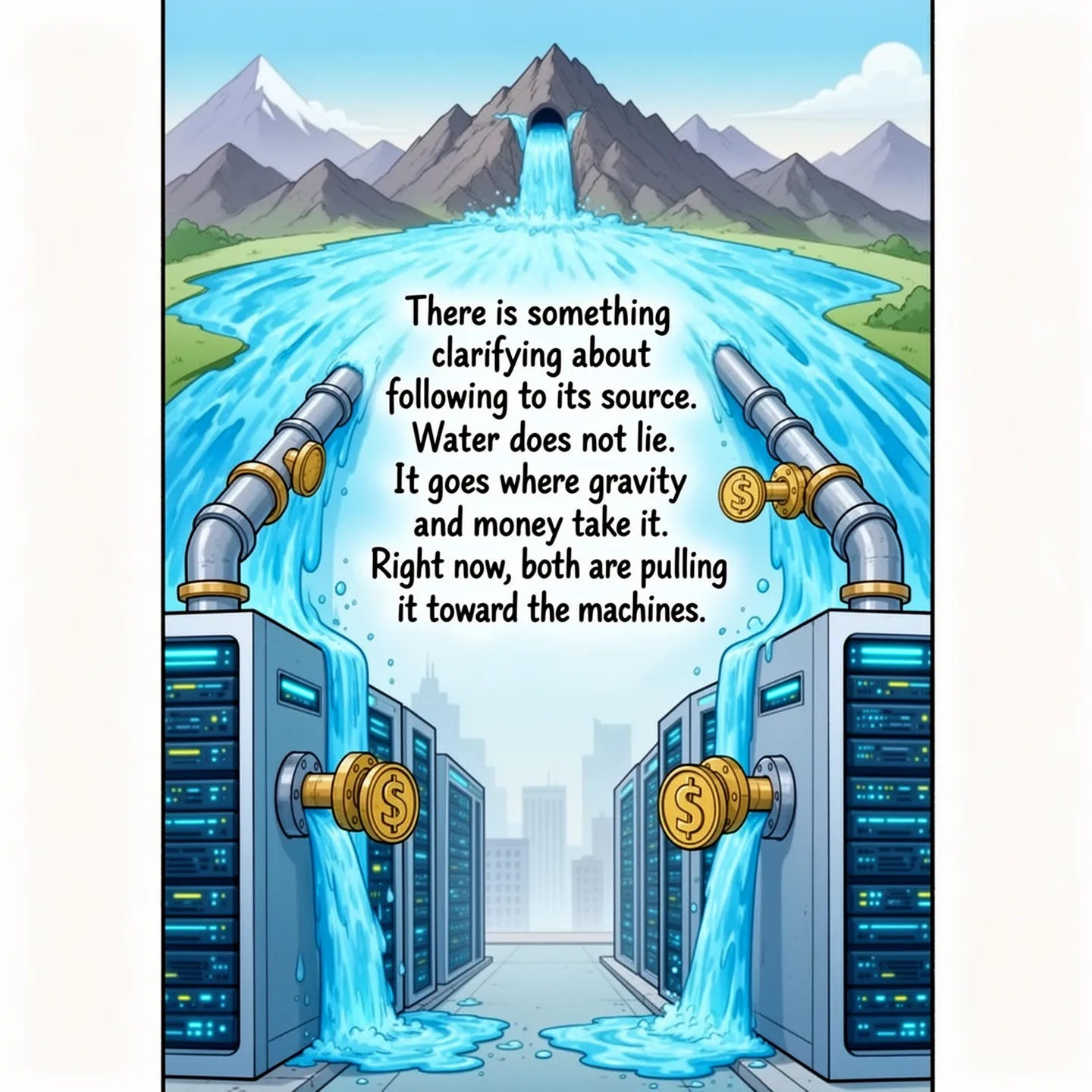
A note to myself: There is something clarifying about following a resource to its source. Water does not lie. It goes where gravity and money take it. Right now, both are pulling it toward the machines.
In February 2024, the CEO of Klarna—a Swedish payments company—declared victory over human labor. An AI chatbot, he announced, was doing the work of seven hundred customer service agents. It handled 2.3 million conversations in its first month. Resolution times dropped from eleven minutes to two. The company projected forty million dollars in annual savings.
Then, this year, Klarna started hiring humans again.
“Most of the time,” the CEO admitted, “humans would rather speak to other humans.” The AI had degraded service quality in ways the metrics hadn’t captured. It was fast, but it was also brittle, unable to handle the thousand small variations in how people express frustration or confusion. The efficiency was real. The humanity was missing.
This reversal matters because Klarna was supposed to be the proof case—the company that showed automation could simply replace the human layer. Instead, it demonstrated something more interesting: we are in an interregnum, a period between economic orders where neither the old rules nor the new ones fully apply.
Eighty-eight percent of organizations now use AI in at least one business function, up from twenty percent in 2017. Yet only six percent report significant impact on their bottom line. The technology is here; the reorganization of work to exploit it is not. We have the tools for a new economy but not the instructions.
I spent years living in different countries—Bali, the Azores, Canada, the Middle East—and in each place I met people wrestling with the same foundational question: What happens when the systems we built to serve us begin to run on their own logic?
In Istanbul, where I now split my time, you can feel this question in the texture of daily life. The city layers centuries of economic order atop one another—bazaar economics, industrial manufacturing, platform delivery apps. A shopkeeper in Kadıköy might use AI to manage inventory while his neighbor sells spices the way his grandfather did. Both are correct. Neither is winning.
The interregnum is not a crisis in the usual sense. It’s a suspension—a period when the old world is dying and the new one is not yet born. The Italian philosopher Gramsci coined the term from a hospital bed under fascism. He wrote that in such times, “a great variety of morbid symptoms appear.”
I think we are seeing those symptoms now.
In Nairobi, a man named Naftali Wambalo sits in an office reviewing content for OpenAI and Meta. He has a college degree in mathematics. He is paid two dollars an hour. Internal documents show that the outsourcing firm receives $12.50 per hour for his work. The margin disappears into corporate structures that span continents.
Wambalo’s job is to look at images and text that AI systems cannot yet process safely on their own—violence, abuse, self-harm, the raw sewage of human behavior that the internet produces in endless quantities. “I looked at people being slaughtered,” he told journalists. “People engaging in sexual activity with animals. People abusing children. People committing suicide.”
His wife said he became a different person. She left him. He is now among two hundred workers suing the companies that employed him.
This is what lies beneath the smooth surface of AI: human labor, often traumatized, always underpaid, performing the work that machines cannot do. The intelligence is not artificial; it is a product assembled from human judgment, human attention, human suffering, then packaged and sold as something clean and new.
I keep returning to this when I work on AIInflection.xyz—the question of what we’re actually building. Not intelligence from nothing, but a system that extracts value from people at the margins and concentrates it among people at the center. The pattern is old. The speed is new.
In the Philippines, 1.3 million people work in business process outsourcing—call centers, data entry, content moderation. The industry contributes thirty billion dollars annually, eight percent of the country’s GDP. A young agent named Renso Bajala describes how AI now monitors his every call, scoring his tone, pitch, speed, and mood in real time. “I have to please the AI,” he says. “It’s like we’ve become the robots.”
A note to myself: The question is not whether AI will replace workers. The question is what kind of work it creates for those who remain. To be monitored by an algorithm that grades your emotions is not the same as being managed by a person. It is a different relationship to your own labor—and to yourself.
What do we call an economy that is neither capitalism nor something else? The Greek economist Yanis Varoufakis argues that capitalism, strictly speaking, has already ended. In its place has risen what he calls techno-feudalism—a system where rent has triumphed over profit, where digital platforms function not as markets but as private estates extracting tribute from everyone who enters.
Think of Amazon. A traditional retailer makes money by buying goods cheap and selling them dear—the classic capitalist formula. Amazon makes money differently. It charges sellers fees to access its platform, fees to advertise, fees to store inventory, fees to ship. Nearly half of every dollar a third-party seller earns on Amazon goes back to Amazon. The company doesn’t need to sell anything itself. It owns the land on which commerce happens.
This is not a market. It is a fiefdom. And the lord of the fiefdom sets the rules.
Varoufakis identifies three new classes: the cloudalists, who own the platforms; the vassal capitalists, who depend on those platforms to reach customers; and the cloud serfs—you and me—who produce value through our data, our reviews, our attention, without ever being paid. We train the algorithms with our clicks. We are not the customer. We are the product and the labor force simultaneously.
I’m skeptical of grand theories, and techno-feudalism might be one of those terms that clarifies less than it seems to. But something has shifted. When Apple takes thirty percent of every transaction in its App Store, when Google can bury a business by changing its search algorithm, when Amazon can copy a successful product and drive the original seller out of business using data the seller provided—these are not the dynamics of a free market. They are the dynamics of enclosure, of landlordism, of tribute.
The writer Cory Doctorow has a cruder word for it: enshittification. Platforms start by being good to users to attract them. Then they extract value from users to attract business customers. Then they extract from everyone to maximize returns to shareholders. The cycle is predictable, Doctorow argues, and it is accelerating.
The interregnum has a geography.
In northern Virginia, through a corridor known as “Data Center Alley,” seventy percent of the world’s internet traffic passes. Loudoun County alone hosts two hundred operational data centers consuming twenty-nine million square feet. Six thousand diesel generators stand ready for backup power. In July 2024, sixty data centers dropped off the grid simultaneously during a power surge, forcing emergency load management to prevent blackouts.
Residents have begun to push back. In Warrenton, Virginia, voters threw out their entire pro-data-center town council in November 2024. Among those leading the opposition: the actor Robert Duvall, whose farm sits nearby. In Prince William County, a $24.7 billion project called “Digital Gateway”—thirty-seven data centers near Manassas National Battlefield Park—was voided by a circuit court judge in August 2025. Across the country, community opposition has blocked or delayed sixty-four billion dollars in data center investment.
These are not NIMBY protests. They are something closer to an immune response—a recognition that the costs of the digital economy are not distributed evenly, that someone must live next to the humming servers and breathe the diesel exhaust when the generators kick on. The cloud, it turns out, lands somewhere. And the people who live there are starting to say no.
A note to myself: Resistance often begins at the periphery. The center is too invested in the system to see it clearly. It’s in small towns along rivers, in agricultural counties running out of water, that the real shape of the transformation becomes visible.
Let me tell you what I think is happening, though I want to be careful about certainty.
We are moving from an economy where labor was essential—where even the exploitation of workers affirmed their importance—to an economy where labor is increasingly optional. This is not the same as unemployment. It is something stranger: the slow demotion of the human being from protagonist to supporting character in the story of production.
A recent MIT study found that AI can already replace nearly twelve percent of the U.S. labor market—$1.2 trillion in wages across finance, healthcare, and professional services. Amazon’s internal documents, leaked this year, revealed the company’s goal: automate seventy-five percent of operations by 2033. An experimental facility in Louisiana already employs twenty-five percent fewer workers than it would without automation. The company projects avoiding six hundred thousand hires over the coming years, saving $12.6 billion.
The language matters. Internal guidelines advised employees to avoid words like “automation” and “robots.” The preferred terms were “advanced technology” and “cobot.” The goal is not just to change the workforce but to change how we talk about changing the workforce.
On AIInflection.xyz, I’ve been mapping these shifts—tracking the gap between what companies say and what they do, between the promise of AI-enabled productivity and the reality of AI-enabled extraction. The pattern that emerges is not reassuring. It is not a story of technology serving human flourishing. It is a story of technology reorganizing human societies around its own logic, with humans increasingly serving the machine rather than the reverse.
And yet.
When I stand back from the data, something else comes into focus—something the grand narratives tend to miss. Klarna rehired its human agents. Companies that rushed to replace workers with AI now report, in surveys, that fifty-five percent regret the decision. Carnegie Mellon ran an experiment simulating an AI worker in a software company: it completed just twenty-four percent of assigned tasks.
The gap between AI’s promise and its performance is real. So is the gap between what the technology can do in a lab and what it can do in the mess of actual work, with its ambiguity, its human relationships, its need for judgment that no algorithm yet possesses.
In 2023, Hollywood writers and actors went on strike for 148 days—the first combined action since 1960. AI was at the center. Studios had reportedly planned to wait until “many writers would be financially strained to the point where they would lose their housing.” The workers won. AI cannot replace writers. Studios must disclose AI-generated material. Background performers cannot be scanned and used “for the rest of eternity” without compensation.
In Kenya, the workers who trained ChatGPT are forming a Data Labelers Association. In the Philippines, the BPO Industry Employees’ Network is consulting with thousands of workers on AI impacts. In Sacramento, two hundred trade union members gathered in January to strategize collective responses—dock workers, nurses, actors, teachers, state employees.
The transformation is not a wave washing over passive subjects. It is contested. It generates friction. And friction, in a system, is not only a cost. It is also information.
I want to end with a question rather than an answer, because I think that’s where we actually are.
The economist Erik Brynjolfsson asks whether AI will augment human work or automate it away. The distinction matters. Augmentation means building tools that extend human capability—that make us more effective, more creative, more powerful in what we do. Automation means building systems that replace us, that do what we did without needing us at all.
The technology can go either way. But the incentive structures, as currently designed, push toward automation. Why pay a person when a machine will do? Why share productivity gains with workers when you can capture them for shareholders? Why build tools that serve humans when you can build platforms that extract from them?
This is the question I return to again and again on AIInflection.xyz and Dari Foundation : not whether AI is good or bad, but who it is good or bad for. Who captures the value? Who bears the cost? Who decides?
In The Dalles, Oregon, the Columbia River still flows past Google’s data center. The company is building two more facilities. Water use is projected to climb further. The trout that once spawned in the tributaries are in decline. Farmers downstream are watching their allocations shrink.
The machines we built to think for us are now competing with us for the basic resources of life. This is not a metaphor. It is happening, in specific places, to specific people, right now.
And we have not yet decided what to do about it.
A final note: When I started working on AI risk, I expected to find a technical problem—something that could be solved with better code, better incentives, better policy. What I found instead was a question about who we are and what we value. The technology is not the answer. It is the surface on which the question is written.
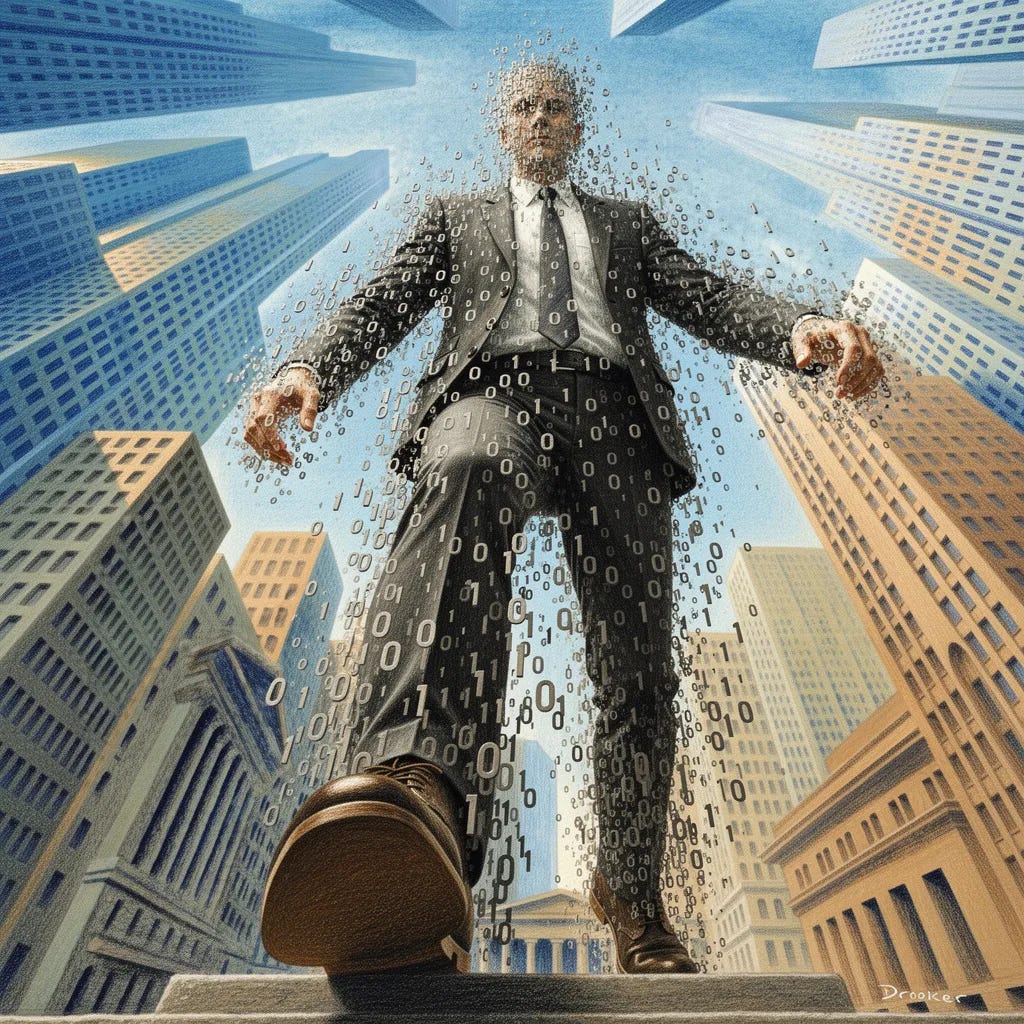
In Filipino call centers, workers describe their new condition in simple terms. “Multinational companies came here because of our skill in customer care,” one union leader told journalists. “And that’s the first thing being displaced by AI.”
She paused. “But somebody still has to train the AI. Somebody still has to check its work.”
Then the question: “Who gets to do it—and what do they get paid?”
This is the interregnum. Not the future arriving, but the present suspended between what was and what will be. The old economy is dying. The new one has not yet been born. In between, a great variety of morbid symptoms appear.
And in between, also: choices. Friction. Possibility.
The machines are coming. They are already here. But they still need water, and electricity, and human hands to catch their mistakes. They still land somewhere, in actual places, with actual consequences.
The question is whether we are building a world where people serve machines, or a world where machines serve people. The answer is not yet written.
That is the only reason for hope.
I believe the future where robots take over is still quite far in the future. With that being said, I think we’re quickly replacing humans job with robots, which will make the human lives significantly worse unless we find something as a society to replace work with.
Over the past few centuries the center of gravity in the builder space has shifted from the hands of human individuals into the hands of the sociocultural institutions we have built…corporations, cartels, and their government sponsors. The world that is being built and the role that AI is being called to serve is now determined by the motives and inclinations of these institutional beings. While people focus upon the problem of “alignment” of AI with human values, the bigger problem is the conduct of these institutions completely out of alignment with what we as living organisms in community would hold most dear. In my mind that is the big deal here and the challenge. These institutional beings and the associated ecosystem of living systems that we continue to build and serve, have been running rogue for a while leaving wreckage in their wake. Great article here describing the material and human dimensions of this wreckage. Reason for hope? Most days I figure it’s a fair coin toss at best.