The Silence Ratio
On the unmeasured nutrient that makes consciousness possible

This is the last day of 2025, and I find myself doing what I’ve done at the close of each year for the past several: sitting with ideas that have been fermenting, sometimes for months, sometimes for years, waiting for the moment they’re ready to be written. Over the coming weeks, I’ll be sharing several of these—pieces that feel, in ways I can’t fully articulate, like they’ve been waiting for exactly this threshold between years to emerge.
This particular essay has been with me longer than most. It began as a fragment I scribbled in Istanbul during a power outage one of those rare moments when the city’s relentless hum suddenly ceased and I could hear, for the first time in months, something I can only describe as the texture of my own thinking. That night, I wrote a single sentence: We are starving for something we have no name for.
I’ve since come to believe that we do have a name for it, or at least we can construct one. I’m calling it the Silence Ratio.
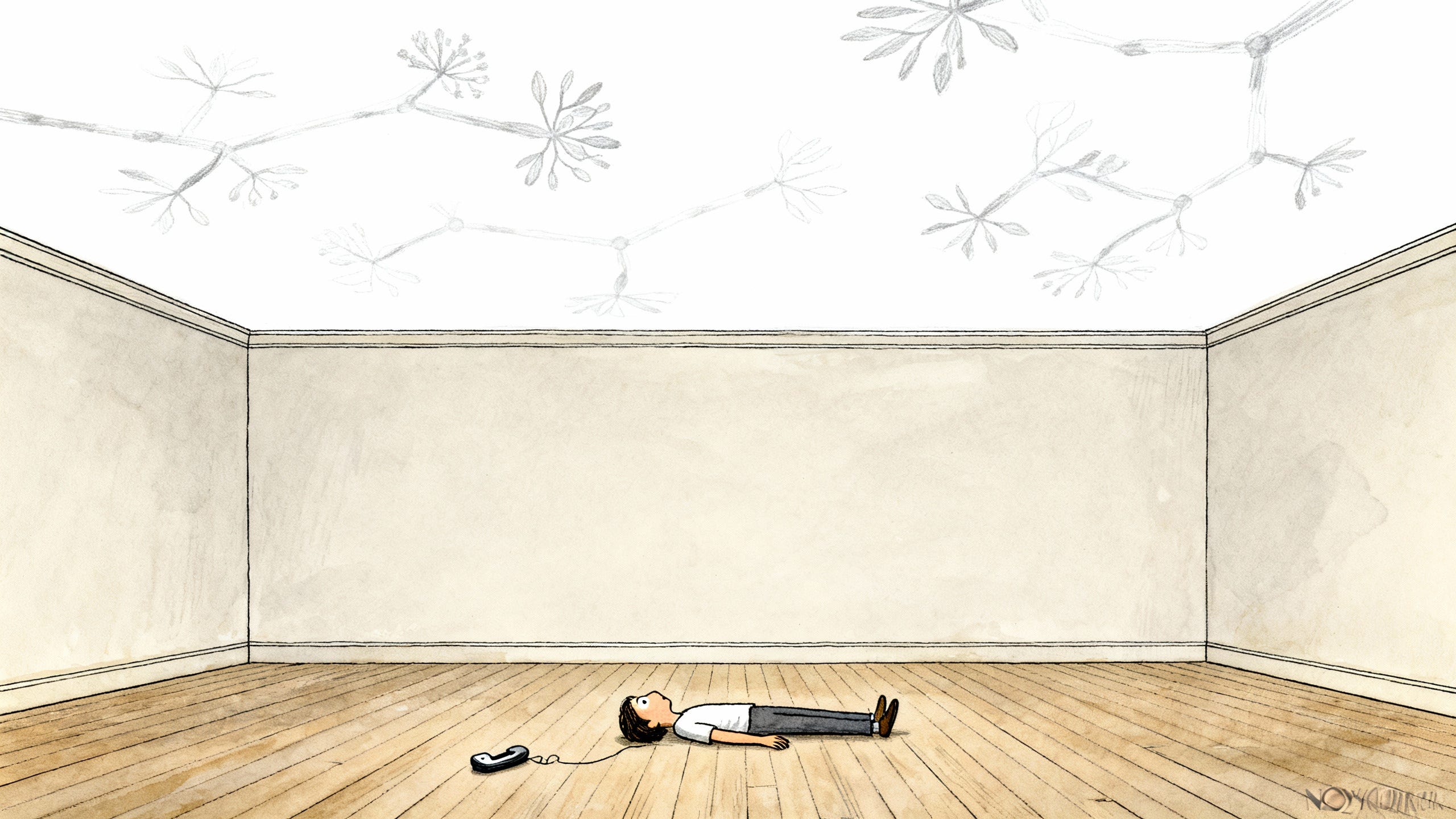
In every human environment, there exists a proportion measurable in principle, though we have not yet learned to measure it between the space that is filled with meaning-carrying signals and the space that is left unfilled, unpatterned, undemanding of attention. I am calling this proportion the Silence Ratio.
This is not a metaphor. Or rather, it began as one and has since revealed itself to be something more literal, more consequential, than I initially understood. The Silence Ratio is to consciousness what oxygen saturation is to blood: an ambient condition so fundamental that we only notice it in its absence, and by then, the damage may already be done.
We speak easily of pollution. We measure particulates in the air, heavy metals in the water, microplastics in the soil. We have developed sophisticated instruments for detecting the presence of substances that do not belong. But we have no equivalent vocabulary, no equivalent instrumentation, for the pollution of silence the saturation of an environment with signals that demand processing, with patterns that require response, with meanings that insist on being metabolized.
I want to be precise about what I mean by silence here, because the word carries associations that might mislead. I do not mean the mere absence of sound. A forest is rarely quiet it is full of bird calls, wind through leaves, the crack of branches—and yet it maintains a high Silence Ratio. A soundproofed room, by contrast, can have an extremely low Silence Ratio if it contains a screen that flickers with notifications, a phone that might vibrate at any moment, the lingering expectation of interruption.
Silence, as I’m using the term, refers to semantic space that is available for endogenous pattern generation. It is the portion of experience that is not already filled with external demands on attention not already structured by someone else’s rhythms, meanings, and intentions. It is the blank canvas upon which the mind can project its own patterns, the empty stage upon which one’s own thoughts can walk.
The developmental implications of this are profound and, I believe, not yet adequately understood.
Consider two children growing up in different environments. The first lives in a home where screens are rare, where periods of unstimulated time are normal, where boredom is permitted to complete its natural cycle. When this child encounters an empty hour, she must generate her own content: invent a game, construct a narrative, discover patterns in the texture of the ceiling, follow a train of thought to wherever it leads. Her consciousness learns to produce, not merely to consume.
The second child grows up in an environment saturated with stimulation not through any malice on the parents’ part, but simply through the ambient density of modern life. There is always a screen available, always a notification pending, always an algorithm ready to supply the next unit of content. When this child encounters an empty moment, it is immediately filled from outside. His consciousness learns to receive, to react, to process inputs but it rarely learns to generate.
I am not making a nostalgic argument here, not pining for some imagined past when children played with sticks and developed rich inner lives. I am making a structural claim: that human consciousness requires a certain proportion of unfilled space in order to develop the capacity for endogenous thought, and that we have inadvertently through no one’s intention—engineered environments where this proportion has fallen below a critical threshold.
Below a certain Silence Ratio, I suspect, humans do not develop genuine interiority. They develop reactivity instead an impressive, rapid, flexible capacity to respond to external stimuli, but without the generative core that we associate with depth of character, originality of thought, or what older traditions called the soul.
I want to trace this idea through several domains where I believe it illuminates something that has otherwise remained opaque.
Architecture. We speak of a room’s features its dimensions, its light, its furniture, its materials. But the value of a room may lie less in what it contains than in what it leaves unfilled. The Silence Ratio of a space is the proportion of sensory and semantic capacity that remains available for the occupant’s own patterns. A room cluttered with decorative choices, each demanding acknowledgment, each expressing someone’s intention, may be objectively beautiful and yet offer almost no silence. A room that is simpler, perhaps even austere, may offer a higher Silence Ratio and therefore greater possibility for the inhabitant’s consciousness to expand into the space.
This is why, I think, certain spaces feel expansive despite being small, and others feel claustrophobic despite being large. We are not responding to square footage. We are responding to the Silence Ratio to how much of our attention is being demanded versus how much is left available for our own use.
Conversation. The depth of an exchange is often inversely proportional to how much of it is filled with words. A conversation that is saturated with speech where every pause is anxiously filled, where silence is treated as a failure to be remedied may convey information efficiently but creates no space for understanding to develop. The most profound conversations I’ve experienced were those with the highest Silence Ratio: long pauses, periods of joint contemplation, the willingness to let a thought hang in the air and complete itself in its own time.
The Sufi tradition speaks of sohbet a form of spiritual conversation that is as much about the silences as the words, where presence matters more than content. This is not mysticism; it is an intuitive recognition of the Silence Ratio’s importance for genuine communication.
Education. We have designed educational environments that are almost comically hostile to silence. Every moment is structured, every outcome is measured, every pause is an opportunity for another learning objective. We speak of engagement as though it were an unqualified good as though a child who is constantly stimulated is necessarily better served than one who is sometimes permitted to stare out a window and think about nothing in particular.
But learning, particularly the kind that transforms rather than merely informs, requires processing time—periods when no new inputs are being added and the mind is left to integrate what it has received. This is not idleness. It is the cognitive equivalent of sleep, when memories are consolidated and connections are formed. An education with no silence is like a life with no sleep: it may appear more productive, but the absence of integration makes the activity increasingly meaningless.
The economic dimension of this should not be overlooked.
Modern wealth is increasingly displayed through signal-density. The rich do not merely acquire objects; they acquire experiences which is to say, carefully curated sequences of stimulation. A luxury vacation is one where every moment is optimized, every view is framed, every need is anticipated before it can become conscious. The wealthier the experience, the less unfilled space it contains.
But I wonder if this is precisely backwards. Perhaps actual wealth the kind that conduces to flourishing rather than mere status display should be measured not in signal-density but in silence-access. The truly wealthy person, in this framing, is not the one who can afford the most stimulating vacation but the one who can afford long periods of genuine silence: a home far from roads and notifications, a schedule that permits contemplation, the security that makes it possible to be bored without anxiety.
This would invert much of what we consider desirable. The urban apartment with its constant ambient stimulation sirens, notifications, the awareness of millions of other consciousnesses pressing against one’s own would be revealed as poverty, regardless of its price. The remote cabin with unreliable internet would be revealed as wealth, regardless of its simplicity.
I do not offer this as a prescription. Not everyone can retreat to cabins; not everyone would want to. But I think the framework reveals something about the shape of the crisis we’re in and why the standard responses to it (more wellness apps, more meditation content, more optimized approaches to mental health) seem to make things worse rather than better. We are trying to solve a Silence Ratio problem by adding more signals. It cannot work. It is, structurally, like trying to address dehydration by providing more salt.
There is a darker dimension to this that I have been reluctant to articulate, but which I think deserves consideration.
What if the self that sense of being a coherent, continuous center of experience is not an inevitable feature of human consciousness but a developmental achievement that requires specific conditions? And what if one of those conditions is a sufficiently high Silence Ratio during the formative years?
The self, after all, is a pattern that the mind generates. It is not given from outside; it emerges through a process of internal construction, through the recognition of continuity across experiences, through the integration of memories and projections into a coherent narrative. This is work cognitive work and like all work, it requires time and space. If the environment is so saturated with external patterns that there is no room for endogenous pattern generation, the self may not develop in the usual way.
I am not saying that people raised in low-Silence Ratio environments have no selves. That would be absurd. But I wonder if what they develop is a different kind of self—one that is more reactive than generative, more defined by its responses to external stimuli than by its own internal coherence. A self that is, in some essential sense, thinner than what we consider normal.
This might explain certain phenomena that have puzzled observers of contemporary culture: the apparent difficulty young people have with sustained attention, yes, but also with boredom, with solitude, with the experience of having nothing to do. These are not failures of discipline. They may be symptoms of a consciousness that never had the opportunity to develop the internal resources that make such experiences tolerable.
The contemplative traditions understood this, though they expressed it in different terms.
When the Desert Fathers retreated to the silence of the Egyptian wilderness, they were not simply escaping temptation. They were seeking the environmental conditions in which genuine interiority could develop. When Zen masters designed their monasteries to minimize distraction, they were engineering high-Silence Ratio environments. When Sufi orders practiced extended periods of khalwa spiritual retreat in silence—they were not merely following tradition; they were providing the developmental conditions for what they called the polishing of the heart.
These traditions were not anti-intellectual. Many of them produced extraordinary works of philosophy, poetry, and science. But they understood that intellectual production is downstream of something more fundamental a capacity for endogenous thought that must be cultivated through exposure to silence before it can be directed toward any particular object.
We have inherited the outputs of these traditions their texts, their techniques, their insights but we have largely abandoned the environmental conditions that made those outputs possible. We read Rumi on our phones, between notifications. We practice meditation apps that interrupt our silence with gentle bells and encouraging progress metrics. We have taken the content and discarded the context, and then we wonder why the content no longer seems to work.
I do not have a solution to offer. If I did, it would probably take the form of another signal another piece of content demanding attention in an already saturated environment and would therefore be part of the problem rather than its remedy.
What I can offer is a name. The Silence Ratio. A way of thinking about what we are losing that is more precise than vague complaints about technology or attention or the pace of modern life.
Once you have the name, you begin to see it everywhere. You notice which rooms have it and which don’t. You feel, in conversation, the difference between exchanges that maintain silence and those that fill it. You begin to measure your own life not just by what you accomplish but by how much unfilled space you have access to—how much of your experience remains available for your own patterns rather than being colonized by someone else’s.
Perhaps this is the beginning of something. Not a solution, but a diagnosis. And diagnosis, as any physician will tell you, is often the most important part of treatment. You cannot address what you cannot name.
We have been starving for something we had no name for. Now, perhaps, we do.
This is the first in a series of essays I’ll be releasing over the coming weeks—pieces that have been fermenting, sometimes for years, waiting for the right moment to be shared. I’m grateful, as always, that you’re here to receive them.
— M.
One can also connect the silence ratio to something already relatable, the noise to signal ratio. The "signal", in this case, coming from within even prior to thought.
Very clearly laid out and expressed, thank you. Some spiritual teachers talk about space consciousness versus object consciousness. Your silence ratio is clearly in line with this and gives us something practical and precise to look for, even for those who have done little inner work.