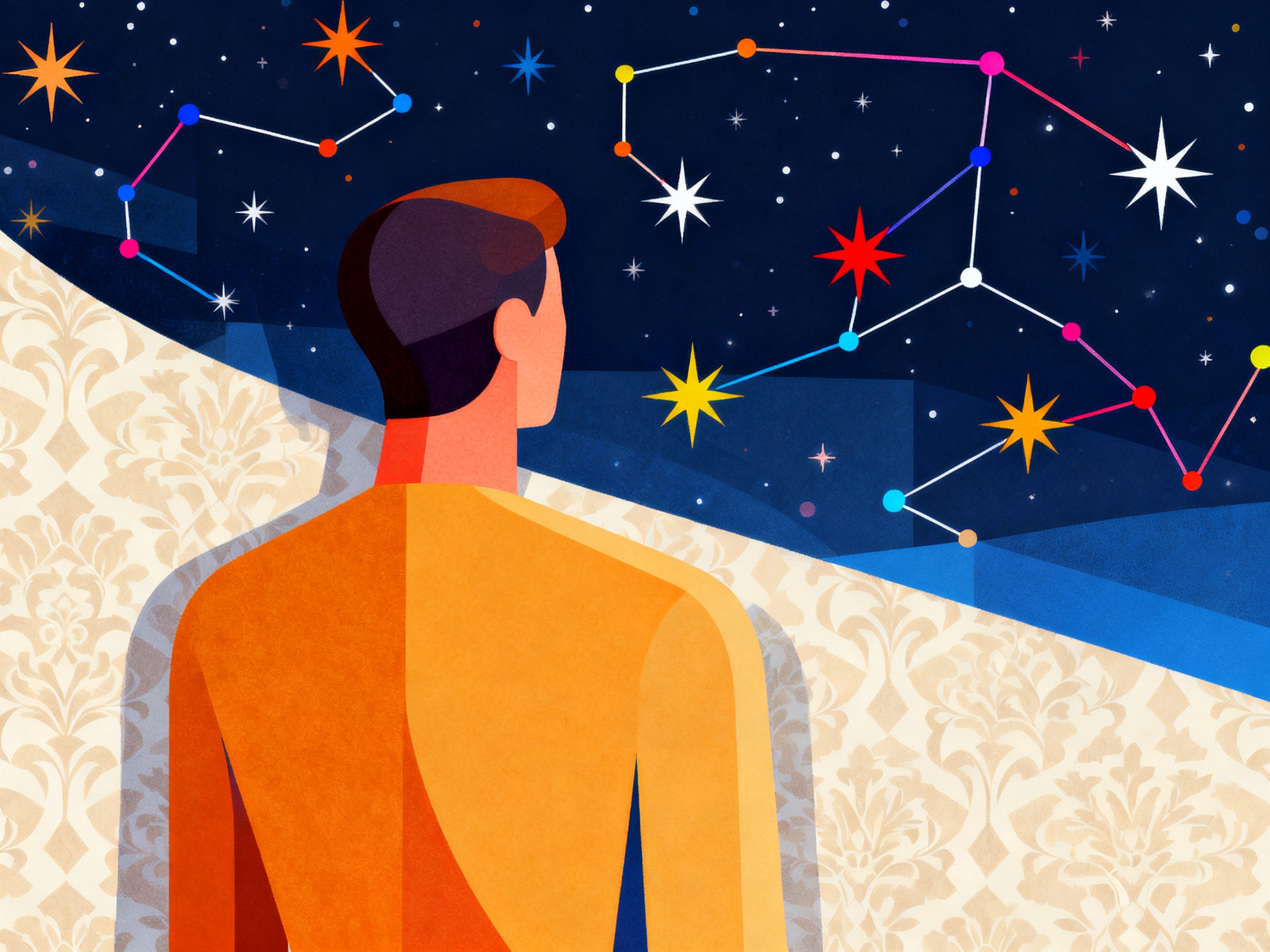
The Sky We Cannot See
On the disappearance of the night, the broken circadian world, and what humans become without their stars

Friend,
I want to begin with a number that has stayed with me longer than almost any other I have come across in writing these letters. It comes from a 2016 paper in the journal Science Advances, by an Italian astronomer named Fabio Falchi and his colleagues, and it is the result of the most rigorous global mapping of artificial sky brightness ever attempted. Falchi’s team combined satellite measurements, ground-based observations, and atmospheric models to produce what they called the World Atlas of Artificial Night Sky Brightness. The atlas is freely available online. I have spent more time studying it than is probably healthy.
The number is this: roughly 83 percent of the world’s population, and 99 percent of the population of the United States and Europe, now lives under skies polluted by artificial light to such a degree that the natural night sky is no longer visible. Roughly one-third of humanity — and 80 percent of North Americans — can no longer see the Milky Way from where they live. The galaxy that has been the visual backdrop of human existence for the entire 300,000-year span of our species’ presence on this planet has been, for most of us, switched off.
I do not say this to be alarmist. The Milky Way, as a galactic structure, is fine. It is in roughly the same place it has been for the past several billion years, doing roughly the same thing. What has changed is our access to it. The sky has not gone anywhere. We have lit up our atmosphere to the point where the sky no longer reaches us.
There is, in 2026, a follow-up paper that has made this picture sharper and more difficult to digest. Christopher Kyba, an astronomer at the German Research Centre for Geosciences, published a study in Science in 2023 using a global network of citizen-science observations — about 50,000 individual records collected over a decade — to track how rapidly artificial sky brightness has been increasing. His conclusion, in the careful language of the paper, was that the average global night sky has been getting brighter at a rate of approximately 9.6 percent per year. Not 9.6 percent over the period of the study. Per year. Compounding.
If you do that math forward, it is sobering. A child born in 2010, in a region with average light pollution growth, will experience a night sky four times brighter when they turn eighteen than the night sky their parents grew up under. The progression is geometric, not linear. We are not merely losing the stars. We are losing them at an accelerating pace.
This letter is about what that means