The Unthinkable Becomes Inevitable
How Economic Systems Die (And What Comes Next)

In 1833, the British Parliament did something that would have seemed impossible just fifty years earlier: it abolished slavery throughout the empire. At the time, Britain’s economy was deeply entwined with the institution—Lloyd’s of London insured nearly every slave trading voyage, sugar plantations in the West Indies generated enormous wealth for British investors, and the Lancashire mills, employing nearly half a million textile workers, ran entirely on cotton picked by three million enslaved people in the American Deep South. Slavery wasn’t merely an economic feature of the British Empire; it was, in many ways, its foundation.
And then, suddenly, it wasn’t.
The question that haunts historians is not simply why slavery ended, but how something so economically entrenched, so profitable, so seemingly essential to the functioning of civilization, could vanish so completely that within a generation it became morally unthinkable to most people in the societies that had once depended on it. The answer to that question and the mechanisms by which an economic system transforms from inevitable to obsolete may tell us something crucial about our own moment in history.
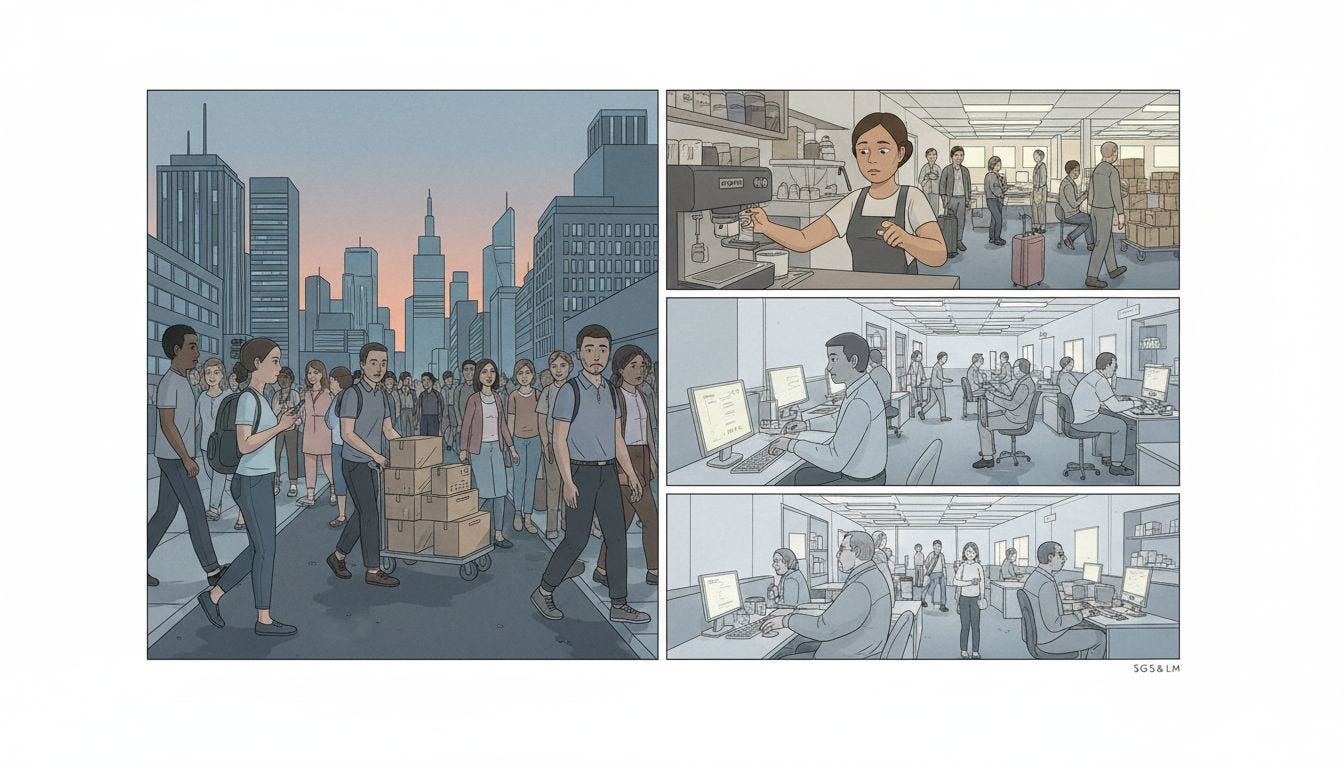
The Economic Logic of the Unthinkable
For most of human history, slavery was simply a fact of life. It wasn’t considered a moral question any more than the existence of rain. It was simply how the world worked.
What made slavery in the Americas different was that it became integrated into something new: an emerging global capitalist system. Plantations were rationally organized on a massive scale for the systematic production of commodities sugar, cotton, tobacco, coffee bound for an increasingly global market.
The profits were staggering. By 1860, cotton alone provided over half of all U.S. export earnings. Slavery wealth contributed to a 3.5 percent increase in British national income. These weren’t marginal operations. This was the engine of economic growth in the most advanced economies in the world.
So why did it end?
Three Theories of Transformation
The standard narrative says moral reformers gradually convinced society that slavery was wrong. It’s a comforting story. It’s also incomplete.
Historian Eric Williams offered a more cynical interpretation. Slavery was only abolished when it made economic sense for the right people. Industrial capitalists needed wage laborers who could also be consumers, workers who could buy manufactured goods. They needed urban development, which plantation slavery inhibited. Moral arguments gained traction when they aligned with economic interests of an emerging power bloc.
A third theory, increasingly prominent in recent scholarship, centers the agency of enslaved people themselves. From the Haitian Revolution of 1791-1804 the only successful slave revolt in history to the daily acts of resistance on plantations across the Americas, enslaved people never accepted their bondage as natural or inevitable. They sabotaged production, ran away, organized rebellions, and when given the opportunity, fought wars of liberation. The legal and economic structures of slavery were constantly being “chipped away,” as historian Adriana Chira puts it, by small, concrete actions that “served to corrode the legal structures of plantation slavery locally.”
The truth, almost certainly, is that all three factors mattered. Economic transformation created the possibility of abolition. Moral arguments gave it political legitimacy. And the resistance of enslaved people made the system increasingly unstable and costly to maintain. What’s striking, though, is how quickly the transformation happened once it began, and how completely the old system was discredited once it ended.
The Pattern of Paradigm Collapse
Looking back, we can see a pattern in how slavery ended a pattern that might illuminate how other economic systems transform or collapse.
First, there’s a long period when the system seems eternal and inevitable. Slavery existed for thousands of years. Classical economists from Adam Smith onward recognized its inefficiencies Smith himself wrote in “The Wealth of Nations” that slave labor “though it appears to cost only their maintenance, is in the end the dearest of any” but this analysis barely dented the institution’s legitimacy. As late as the 1850s, American slave owners were confident about the future and the system was expanding.
Second, new economic realities begin to create structural conflicts with the old system. The agricultural revolution in Britain in the 1600s created food surpluses and population growth, which in turn created a class of wage laborers. These workers became both producers and consumers a market economy required both. Plantation slavery, by contrast, actively inhibited urbanization, mechanization, and the development of consumer markets. The two systems could coexist for a while, but they were fundamentally incompatible.
Third, moral and political movements emerge that articulate the conflict in ideological terms. The Enlightenment language of liberty and human dignity, the evangelical Christian emphasis on the equality of souls, the revolutionary rhetoric of the American and French revolutions all of these provided frameworks for understanding why slavery was wrong. But crucially, these movements gained power not in isolation but in conjunction with changing economic realities.
Fourth, there’s a cascade. Once the system starts to fail in one place, the failure spreads. Britain abolished the slave trade in 1807 and slavery in 1835. Northern U.S. states followed quickly. By the 1880s, Brazil and Cuba had abolished slavery. What had been unthinkable became, in less than a century, mandatory.
Finally, and perhaps most remarkably, there’s a rapid moral reconstruction. Within a generation of abolition, slavery went from being a normal feature of civilized society to being a moral abomination that discredited anyone who defended it. The economic logic that had justified it for centuries was suddenly revealed as a rationalization for cruelty. People who had built their entire worldview around slavery’s necessity found themselves unable to articulate that worldview in public.
The old paradigm didn’t just end. It became, retroactively, indefensible.
The Multipolar Trap
Which brings us to now.
We live in a global economic system that everyone with any sense agrees is unsustainable. We’re burning fossil fuels at a rate that will make large portions of the Earth uninhabitable. We’re extracting materials and producing waste at scales that destroy ecosystems. We’re trapped in financial structures that require endless exponential growth, even as we approach planetary boundaries. The wealth generated by this system is concentrating in fewer and fewer hands, while billions of people lack access to adequate housing, healthcare, and food.
And yet we keep doing it. Every nation, every corporation, every individual actor in the system is locked into a kind of prisoner’s dilemma. If any single country decides to prioritize long-term sustainability over short-term growth, it risks being left behind by competitors. If any single corporation tries to operate on truly regenerative principles, it will be undercut by competitors who externalize their costs. If any individual tries to exit the system entirely, they risk poverty and social marginalization.
This is what game theorists call a multipolar trap. Everyone can see the problem. No one can afford to stop. Stopping first means losing.
The global money supply has increased thirty-fold since 1970, while real economic productivity has lagged far behind. This exponential creation of money forces economies into endless growth mode, regardless of consequences. Debt-based money creation means the system collapses if it stops expanding. To keep up with financial expansion, we burn fossil fuels, minerals, and natural resources at exponential rates. We turn 100 billion tons of material into 40 billion tons of waste and pollution every year, not because anyone wants to, but because the system is optimized to do exactly that.
Eighty-five percent of global energy still comes from fossil fuels, and every sector—transportation, agriculture, manufacturing, finance depends on them. Even as renewable energy grows, global energy demand continues to increase, keeping fossil fuels dominant. Breaking free from the fossil economy means redesigning every aspect of civilization.
Sound familiar? It’s the same basic structure as the slave economy in the 1700s. An economic system so profitable, so entrenched, so fundamental to how the world works that imagining its end seems impossibly naive. And yet, we know from history that such systems do end. They don’t end gradually or peacefully. They end when multiple forces converge economic transformation, moral movements, and the actions of people who refuse to participate in the system anymore to create a cascade that makes the unthinkable inevitable.
The Three Constraints
If we apply the pattern of slavery’s abolition to our current predicament, three constraints emerge as critical.
The first is coordination. The core problem with the multipolar trap is that it’s a coordination failure. Everyone would be better off if we all agreed to transition away from extractive economics simultaneously, but no one wants to go first. What broke the slavery system wasn’t just moral arguments or economic self-interest it was coordination among previously disconnected groups. Working-class British families, religious reformers, industrial capitalists, enslaved people fighting for freedom these groups had very different interests and motivations, but they aligned, temporarily and imperfectly, to create enough political pressure to force change.
Today, any solution to the climate crisis, the inequality crisis, the resource depletion crisis must solve the coordination problem. How do we get the majority of people who currently lack the resources to make change themselves to come together and coordinate their efforts? The answer, according to some theorists, lies in recognizing that people themselves are the most fundamental resource. If the majority who lack financial, political, or material power could coordinate effectively, they would have immense power to reshape the system.
The second constraint is material. The slave economy was materially dependent on a specific system of production plantations that converted land and labor into cash crops for export. When new agricultural and technological innovations made alternative forms of production viable and profitable, it became possible for economic elites to imagine a world without slavery. The Industrial Revolution didn’t cause abolition, but it created the material conditions that made abolition economically feasible for enough powerful people to matter.
Today, our material economy is based on burning fossil fuels to generate energy, which we then use to extract materials, manufacture goods, and create waste. Nature, meanwhile, operates a much more successful economy one that efficiently uses the 172,000 terawatts of energy the sun provides for free, that builds complex structures through growth rather than extraction, that produces no waste because everything is an input for another process.
The question is whether we can transition to a material economy based on natural processes one that uses renewable materials like hemp, bamboo, mycelium, and algae instead of concrete and steel; one that captures solar energy directly through biological systems instead of burning ancient sunlight; one that designs products to decompose and regenerate instead of accumulating in landfills.
The third constraint is age. This might be the most interesting insight from the abolition parallel. When slavery ended, it wasn’t primarily the slave owners who changed their minds. Most of them went to their graves defending the institution. It was the next generation people who hadn’t yet built their lives around the system who embraced the new paradigm.
Today, roughly 42 percent of the world’s population is under 25 years old. Many of them already see no viable future in the existing system. Climate anxiety is rampant. Job precarity is the norm. Wealth concentration means traditional paths to prosperity are closed off. Unlike older generations, they’re not yet fully financially or socially dependent on the extractive economy. They have less to lose by embracing something radically different.
Add to this the 1.5 billion people expected to be displaced by climate change by 2050 climate refugees who are already being ejected from the old system and forced to find alternatives and you have a massive population cohort that might be ready for a new economic paradigm simply because they have no place in the old one.
The Heliogenic Alternative
This is where the story gets speculative, but usefully so. Because if we accept that economic paradigm shifts are possible that systems as entrenched as slavery can end and be replaced by something fundamentally different then the question becomes: what might that something different look like?
One answer comes from a movement that calls itself heliogenesis. The core idea is deceptively simple: build a civilization that runs on the sun, not on extraction.
This doesn’t just mean solar panels, though those are part of it. It means reconceiving the entire material basis of civilization around biological processes that capture and structure solar energy. Instead of mining, we grow materials using hemp, bamboo, mycelium, bacteria and algae materials that sequester carbon as they grow and can be composted when we’re done with them. Instead of building structures, we cultivate them using living materials that self-assemble and self-repair. Instead of extracting energy from fossil fuels, we work with the 172,000 terawatts the sun already provides.
The heliogenic framework proposes that buildings should function like forests growing their own materials, cleaning air, regulating temperature, generating energy, all while requiring minimal external inputs. That manufacturing should work like ecosystems, where every output is an input for another process and nothing is ever truly waste. That economies should be structured around stewardship rather than ownership, recognizing that we don’t own materials we temporarily shape them before they return to natural cycles.
In other words, heliogenesis imagines a civilization that operates more like nature and less like a machine. This might sound impossibly utopian, but it’s worth remembering that in 1780, a civilization without slavery seemed equally impossible to most people. The moral arguments against slavery existed for centuries before abolition. What changed wasn’t the arguments but the material conditions that made alternatives viable.
Today, we have the technical capacity to build with biomaterials. Hempcrete absorbs 307 kilograms of CO2 per ton. Mycelium-based materials can be grown in 7-14 days with minimal energy input. Bamboo grows thirty times faster than timber and sequesters twelve tons of CO2 per hectare annually. We can produce energy through biophotovoltaic panels using living cells at eighty percent efficiency. We can synthesize industrial materials from sugars using engineered microbes.
The technology exists. What’s missing is the coordination, the material infrastructure, and the population willing to embrace it.
The First Movers
The heliogenesis movement has identified what it calls “Frontline Nations”—countries at the lower end of the global GDP scale that are most vulnerable to the disruptions of climate change and most likely to benefit from alternative economic models. The logic is similar to why Britain, as the most advanced industrial economy of its time, was paradoxically the first to abolish slavery: it had the most to gain from an alternative system.
Nations facing economic crisis, food insecurity, and climate disaster don’t have the luxury of defending the status quo. They’re already experiencing system failure. For them, a new paradigm isn’t a luxury it’s a necessity.
The movement proposes what it calls MIRACLE Factories (part of the oslo project) essentially, entrepreneurial universities focused on developing the practical knowledge, skills, and technologies needed for heliogenic civilization. The first is being built in Auroville, India. A second and third is under construction in Costa Rica and Oslo. Others are planned for Poland, California, and locations yet to be determined. Each factory is meant to adapt to local conditions and bioregional resources while sharing knowledge globally through digital platforms.
The idea is to create living demonstrations that a different kind of economy is possible not as theoretical models but as actual functioning communities where people can see, touch, and inhabit the alternative. When slavery ended, people needed to see that wage labor and industrial production could actually work. We needed factories and cities and consumer markets before we could let go of plantations. Similarly, we may need to see functioning heliogenic communities places where people live comfortably without fossil fuels, where housing is grown rather than built, where material abundance comes from regeneration rather than extraction before the broader society can imagine making the transition.
The Cascade
Here’s what keeps me up at night: the pattern of paradigm collapse suggests that once such a shift begins, it accelerates rapidly. Slavery didn’t end gradually over centuries. It ended in a cascade of abolitions over a few decades, and then became morally indefensible almost overnight. The entire economic and moral logic that had sustained it for thousands of years simply... evaporated.
If our current extractive civilization follows a similar pattern and there’s good reason to think it might then we’re living in one of two possible moments. Either we’re in the equivalent of 1750, when slavery seemed eternal and inevitable despite the early stirrings of moral and economic transformation. Or we’re in the equivalent of 1800, when the cascade was already beginning and everything was about to change, though most people couldn’t see it yet.
The difference matters enormously. If we’re in 1750, then we have time to build alternatives carefully and deliberately, to create the material conditions for a different kind of civilization before the old one collapses. We can be intentional about the transition, minimizing suffering and maximizing the chances that what comes next is actually better.
But if we’re in 1800, if the cascade is already underway, then we’re in a race against collapse. Climate change is accelerating. Inequality is intensifying. Resource conflicts are multiplying. The financial system is lurching from crisis to crisis. The old paradigm is failing faster than the new one is being built.
The optimistic interpretation is that this sense of urgency might actually help. The abolition of slavery accelerated when the system’s contradictions became undeniable when slave revolts made it costly to maintain, when economic alternatives became visible, when moral arguments could no longer be ignored. Perhaps our current polycrisis the convergence of climate, inequality, resource depletion, and political instability is precisely what’s needed to break the multipolar trap. When continuing the existing system becomes obviously catastrophic, the coordination problem might solve itself.
The Unthinkable
There’s a line I keep coming back to from Adam Smith’s “The Wealth of Nations.” Smith was writing about slavery in 1776, at the height of its economic power, and he noted something that must have seemed almost absurd at the time: that slave labor was actually more expensive than free labor because the cost of maintaining slaves—however poorly had to be passed on to consumers, while wage laborers paid for their own upkeep.
Smith was right, of course. Within decades, industrial capitalism demonstrated that wage labor was more profitable than slavery. But here’s what’s remarkable: Smith’s economic analysis existed alongside slavery’s continuation and expansion. Being right about the economics wasn’t enough. The transformation required a convergence of economic self-interest, moral movements, and the actions of enslaved people themselves.
Today, we have mountains of economic analysis showing that renewable energy is cheaper than fossil fuels, that climate change will cost trillions, that inequality drags down growth, that waste and pollution represent enormous inefficiency. We have moral arguments about intergenerational justice and our obligations to other species and the rights of future humans to inhabit a livable planet. And we have millions of people particularly young people and climate refugees who are already being pushed out of the existing system and are desperately seeking alternatives.
All the pieces are in place. What we’re waiting for what we’re building toward is the moment when these pieces converge into a cascade.
The heliogenic framework offers one vision of what might come next: a civilization that works with natural processes rather than against them, that builds abundance through regeneration rather than extraction, that recognizes the sun as the only necessary input and everything else as temporary configuration of matter in service of life. It’s a vision that seems simultaneously impossibly utopian and extremely practical.
But then, in 1780, the idea of a civilization without slavery seemed impossibly utopian too. The planters and merchants and financiers whose wealth depended on slavery couldn’t imagine how the economy would function without it. The idea that everyone including former slaves would be better off in a system based on wage labor and consumer markets seemed like naive idealism.
And yet, here we are. Slavery ended. The economy didn’t collapse. A new system emerged. And within a generation, the old system became so morally indefensible that we can barely imagine how our ancestors justified it.
The question facing us now is whether we can make a similar transition from an extractive civilization to a regenerative one before the old system collapses catastrophically, taking much of human and natural life with it. Whether we can make the unthinkable inevitable before the inevitable becomes unthinkable.
History suggests it’s possible. Recent history suggests it’s urgent. The next few decades will determine whether we’re up to the task.
Because here’s the thing about paradigm shifts: they’re impossible until suddenly they’re not. They’re naive fantasy until suddenly they’re the only option that makes sense. The slave owners of 1850 thought slavery was eternal. By 1900, their grandchildren found the very idea obscene.
We look back at those slave owners now and wonder how they could have been so blind, so morally compromised, so unable to imagine a different world. Our descendants will look back at us the same way—either with gratitude that we managed the transition, or with horror that we didn’t.
The future is wide open. The question is what we build in the space that’s opening.
Much Love
M
I think you provided references for Heliogenesis in the past. Would you please provide links to any new information?
Excellent article.